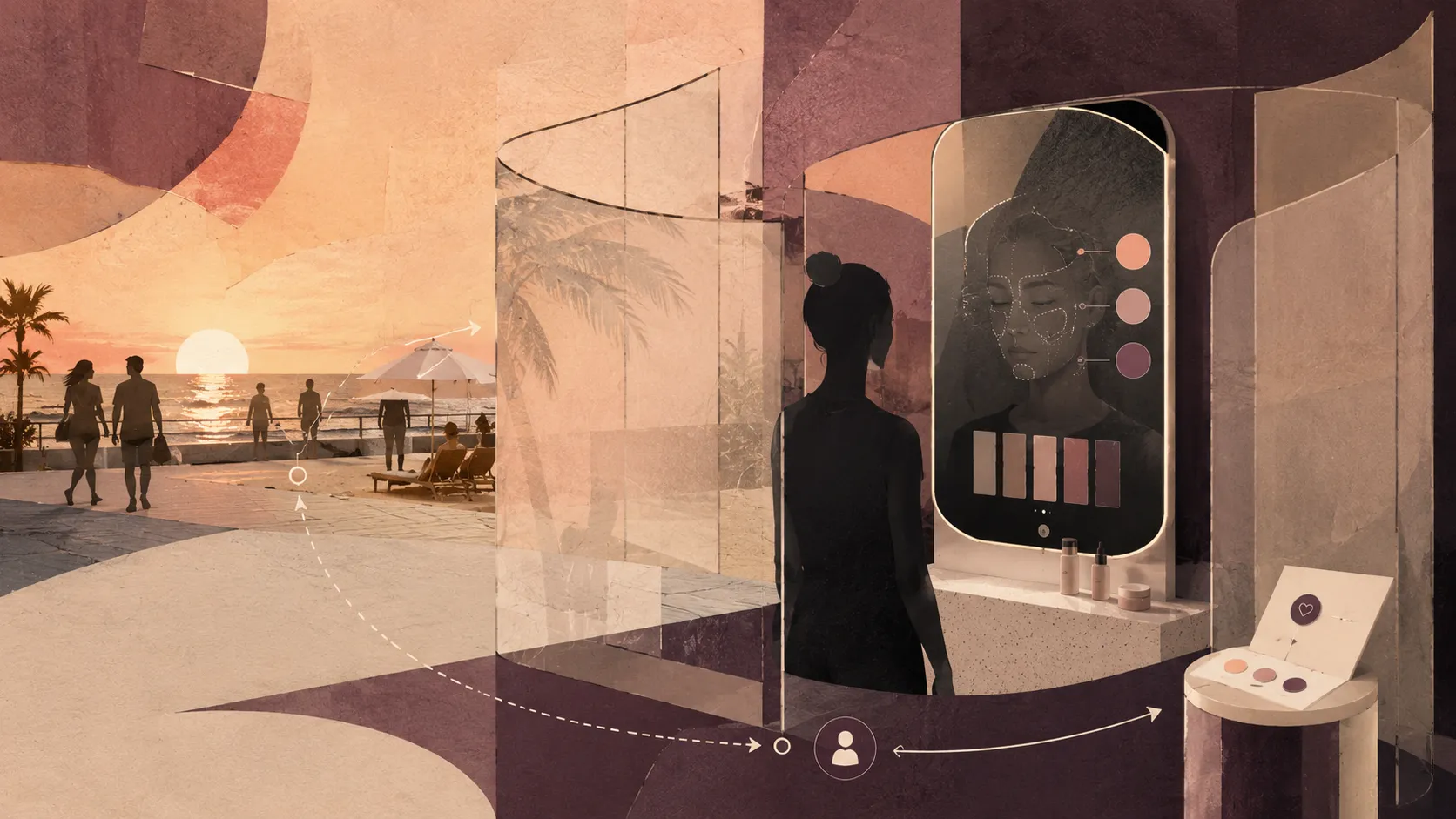
Beauty shoppers often want guidance, but they do not always trust counter recommendations. Advice can feel commission-driven, and trying products in store can be slow or awkward. Mira explores how a physical retail touchpoint can make discovery feel private, guided, and emotionally engaging without removing the brand from the journey. 美妆顾客需要建议,但不一定信任柜台推荐:销售的提成感太明显,现场试产品又慢又尴尬。Mira 探索的是,实体零售里的一个触点,怎样既保留品牌引导,又让顾客觉得私密、清楚、有参与感。
Key Findings核心发现
Trust Deficit Is the Core Barrier 信任缺口才是那个核心阻碍
Customers distrust sales advice when it feels tied to commission. The mirror removes the social pressure while keeping the guidance. 当推荐听起来像是为了提成,顾客就很难信任。镜面界面拿掉了这种社交压力,但保留了被引导的感觉。
Context Shapes Comfort 场景决定舒适度
In testing, a beach setting made skin analysis feel casual instead of clinical. The environment shaped trust as much as the technology did. 测试中,沙滩场景让肤质分析更像轻松体验,而不是临床检测。环境和技术一样会影响信任感。
Public Activity, Private Results 公共参与,私密结果
Users were comfortable doing analysis in an open space (4-5/5 comfort) but wanted results displayed privately. The spatial design needs to support both. 在开放空间做分析,用户是放松的(舒适度 4-5/5),但希望结果是私密显示的。空间设计得同时支持这两种状态。
Clear Steps Over Abstract Metaphors 清楚的步骤,胜过抽象的比喻
Abstract prompts like 'Reflection' confused walk-in users. The interaction needs clear, guided steps, not open questions that make people feel lost. 像「Reflection」这样抽象的词把路过的用户绕晕了。交互要的是清晰、一步步引导,不是让人手足无措的开放式问题。
Mira Mira
The Magic Mirror 魔镜
An AI-powered interactive mirror installed in a beach pop-up beauty counter. It replaces the sales assistant with a friendly, non-judgmental interface that guides customers through skin analysis and product discovery at their own pace. 装在沙滩美妆快闪里的 AI 互动镜。它把销售换成一个友善、不带评判的界面,按顾客自己的节奏带他走过肤质分析和产品探索。
- Voice-activated AI interaction with customizable personality tones 语音唤醒的 AI 交互,人格语气可自选
- Real-time skin analysis using camera and AI processing 摄像头与 AI 处理驱动的实时肤质分析
- Personalized product recommendations based on actual skin data 基于真实肤质数据的个性化产品推荐
The Servicescape 服务空间
A semi-open beach pop-up designed to balance curiosity and privacy. The open layout draws people in, while the mirror station creates a semi-private zone for results: public participation, private outcomes. 半开放的沙滩快闪,在好奇心和隐私之间找平衡。开放的布局把人吸引进来,镜面站本身围出一个半私密的结果区。公共参与,私密结果。
- Open spatial design creates curiosity and feels beach-appropriate 开放的空间设计,既勾起好奇心,也贴合沙滩感
- Semi-enclosed mirror station for private result display 半封闭的镜面站,用来私密地呈现结果
- Natural, casual decorations that match the beach environment 自然、随意的装饰,配合沙滩环境
The Guided Journey 引导旅程
A five-screen interaction flow that replaces abstract prompts with clear, step-by-step choices. Each screen builds on the last, moving from activation to personalization to analysis to results. No open questions, no confusion. 五屏交互流程,把抽象的提示换成一步步清楚的选择。每一屏接着上一屏往下走,从唤醒到个性化到分析再到结果。没有开放式问题,没有困惑。
- Mirror activation with friendly AI voice greeting 镜面唤醒,AI 友好语气打招呼
- Personality and tone selection for the consultation style 选择顾问风格的人格与语气
- Analysis results with private, personal display 分析结果,私密显示
- Email capture for follow-up recommendations 邮箱留存,用于后续推荐
- Reflection puzzle: AI rebuilds the user's image piece by piece as a memorable takeaway 反射拼图:AI 一点点重建用户形象,作为值得被记住的带走物
Why a mirror, not an app
The beauty counter already has a mirror. Every customer walks up to one, looks at themselves, and wonders what would work. Mira doesn’t add a new device to the equation. It makes the existing ritual smarter. The mirror becomes the interface, the consultation happens at the customer’s pace, and the AI replaces the pressure of a human sales assistant with something that has no commission to earn.
That framing matters because the core problem isn’t information access. Customers can Google skin routines all day. The problem is trust in the moment of purchase, standing at a counter, wondering if the person recommending a $60 serum actually cares about their skin or just their quota.
Two prototypes, one experience
We tested Mira as a complete service, not just a screen flow. That meant building two prototypes in parallel and testing them together.
Cardboard Mockup
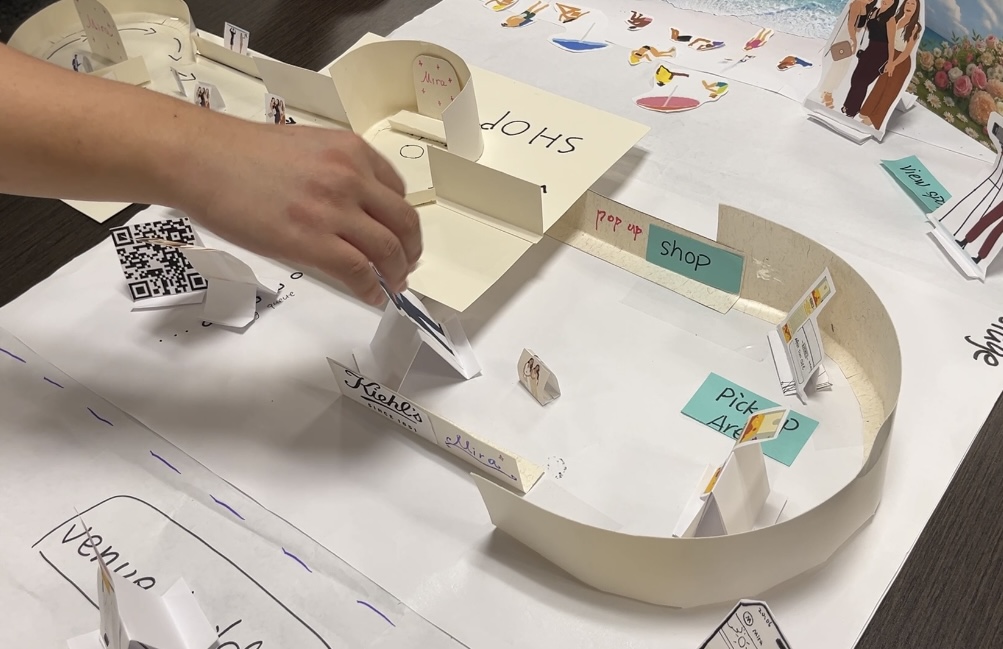
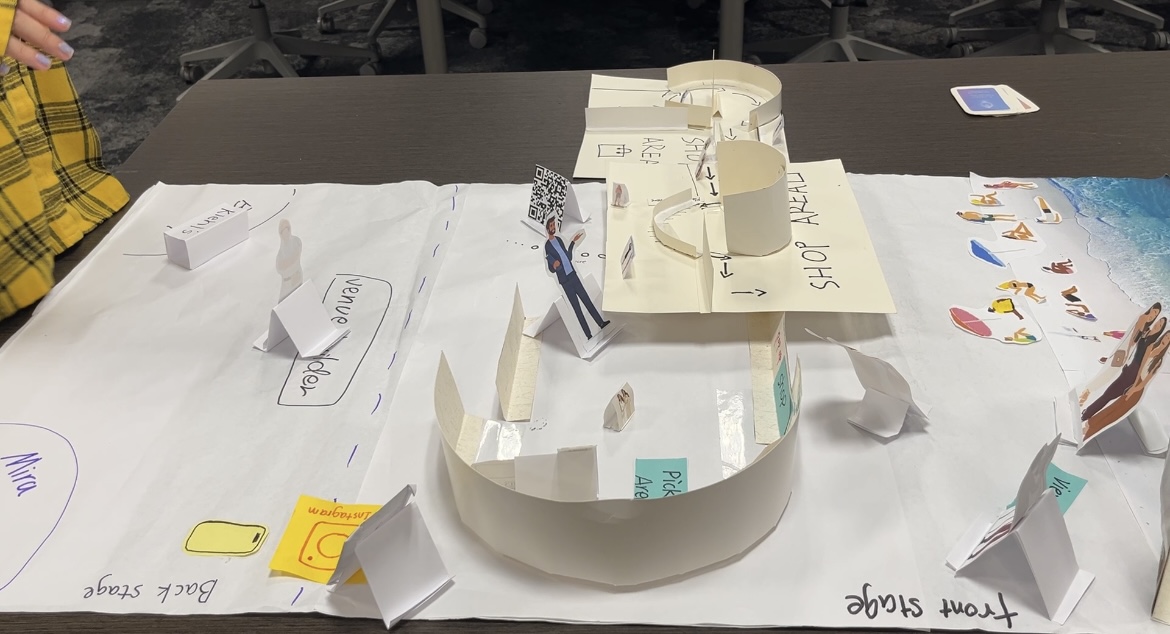
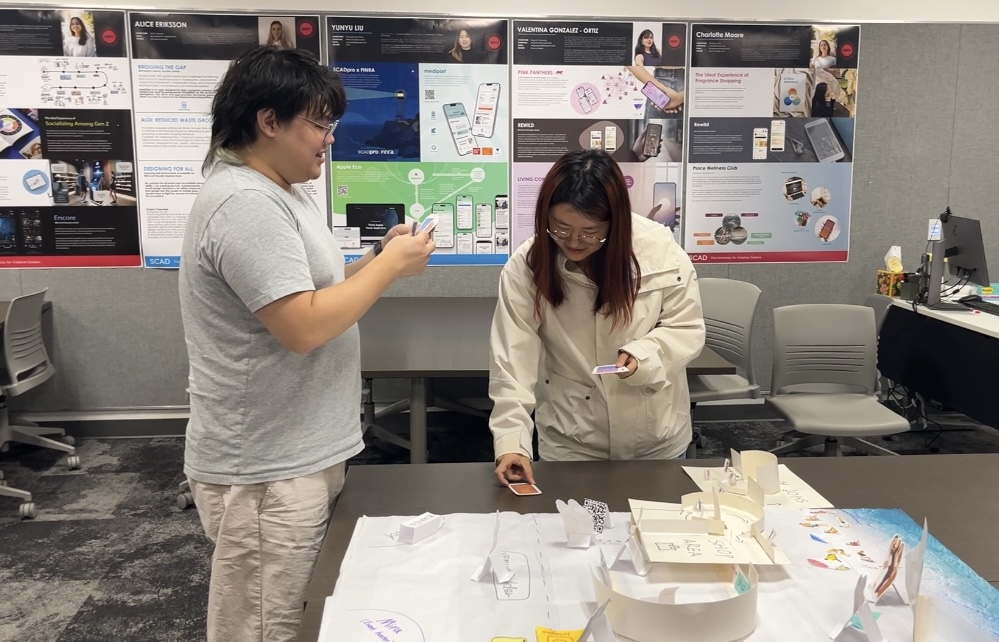
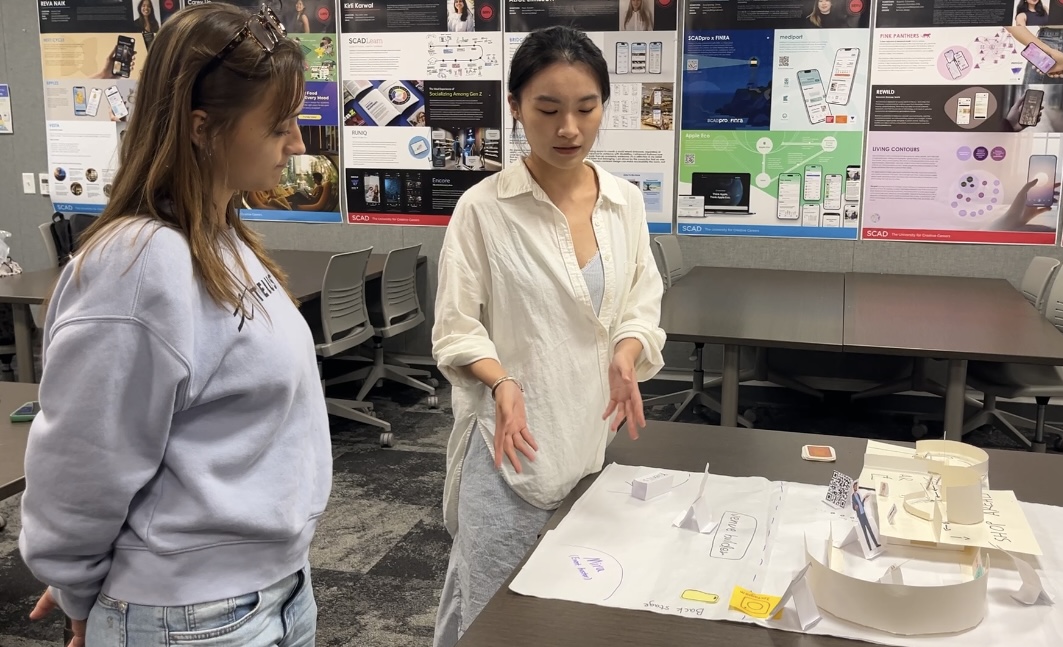
A 1:20 scale model of the beach pop-up environment: cardboard structures, labeled zones, spatial relationships between the mirror station, vendor stalls, and the beach. We needed to test whether the open layout created curiosity or anxiety, and whether the mirror's position felt natural.
Paper Screens
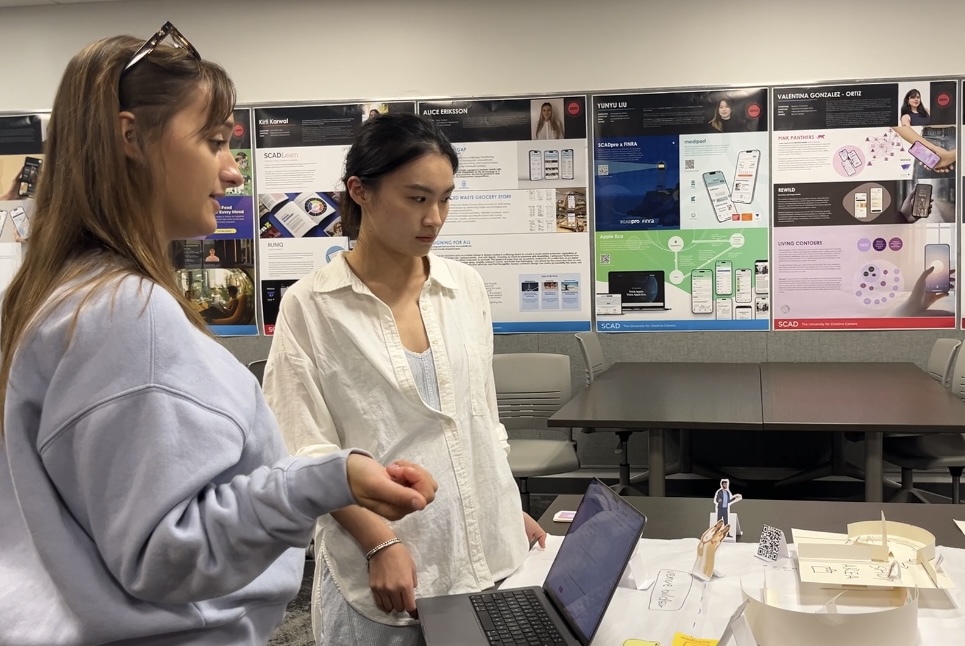
Five paper interface cards representing each screen in the Mira interaction, from the initial mirror activation to the final reflection puzzle. A human stood behind the mirror mimicking the AI's voice responses to test the full conversation flow end-to-end.
Testing them together revealed something we wouldn’t have caught in isolation: spatial comfort and interface clarity are coupled problems. Users felt fine doing the analysis in the open, but the moment personal skin ratings appeared on screen, they wanted privacy. The space needed to support both modes.
See the scenario
We also filmed an in-store scenario play to test how Mira would read inside a traditional beauty counter, the more familiar context customers already know. The video runs through a full consultation: a customer walking up to the mirror, the AI greeting, personality selection, skin analysis, and the reflection puzzle reveal. Watching it end-to-end shows the rhythm of the conversation and where the interface needs to carry the weight when the physical space is just a shelf.
Inside the testing sessions
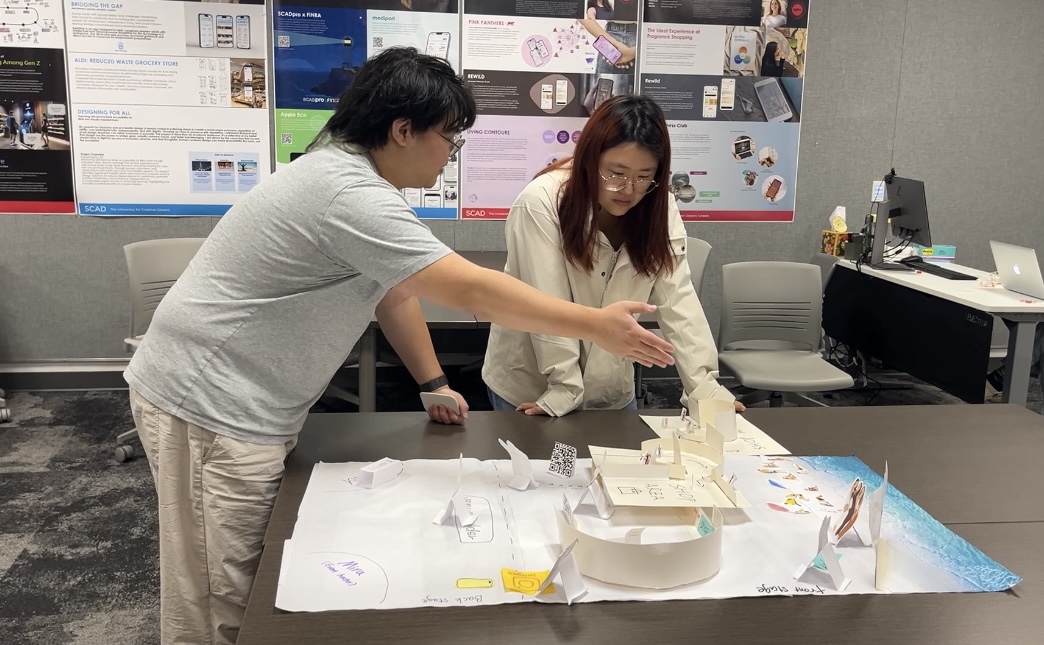
The cardboard model sat on a table in front of printed backdrop walls (vendor stalls, the sea, beachgoers) so that participants could visualize the full pop-up environment while we ran them through the paper screens. A teammate stood behind the mirror voicing the AI’s lines in real time. What the photos don’t show is how fast the feedback loop was: a confused reaction at one screen, the person playing AI noting it, and the next session running with an adjusted line.
The five screens
Mirror Activation
A human mimics AI voice interaction to greet and onboard the user, turning a passive mirror into an active consultation.
Personality Selection
Users choose the tone and dialogue style for their consultation: playful, professional, or somewhere in between.
Analysis Results
Skin analysis data displayed privately on the mirror. The shift from public activity to private results happens here.
Email Capture
Optional email input for follow-up recommendations. Keeps the experience low-pressure: the brand gets a lead, the user gets convenience.
Reflection Puzzle
The payoff moment. AI rebuilds the user's image piece by piece as dynamic visual feedback, a memorable, shareable takeaway that turns a consultation into an experience.
What we validated (and what we didn’t)
"It felt like a special experience, especially because it took place on the beach, creating a vacation-like atmosphere."
Beach context works. All five participants showed interest in the seaside setting. The environment made skin analysis feel natural and relevant rather than clinical.
"Mira's tone feels fresh and interesting, and the interface design looks visually appealing."
Emotional engagement is real. Users in open settings rated their sense of being "transported" at 5/5. The Magic Mirror framing created genuine engagement.
"I would want result privacy. Skin rating is personal. I'd want results just for me, unless I know they're only good results."
Privacy is conditional. Users were comfortable participating openly but wanted results kept private. The semi-open space needs a privacy transition point.
"When I first look at the design, I thought it was luxurious, like for cocktails... beach goers have sand. Should make decoration more casual."
Aesthetic mismatch. The desktop model appeared too formal for a beach context. Decorations need to match the casual, natural environment.
"I don't know what else to talk about."
Abstract metaphors fail in walk-in settings. Non-brand-loyal visitors weren't primed for open-ended conversation. The experience needs clear, guided steps.
Designing for the tension
The hardest design challenge in Mira isn’t the AI or the interface. It’s the spatial contradiction. The experience needs to be public enough to create curiosity (people seeing others use the mirror and wanting to try it) but private enough that users feel safe receiving personal skin data. Our prototype testing confirmed this isn’t a binary choice. The space needs to transition: open at the entry and activation stages, semi-enclosed at the results stage. The “Reflection Puzzle” screen, where AI rebuilds the user’s image piece by piece, was designed as the bridge between these two modes. It’s visually compelling enough to be seen from a distance (drawing others in) while the actual skin data stays on a private portion of the display.
为什么是一面镜子,不是一个 app
美妆柜台本来就有一面镜子。每位顾客走过去,照一下自己,在心里猜哪个适合自己。Mira 不是往里面再塞一个新设备,而是让这个已经存在的仪式更聪明一点。镜子本身变成界面,顾问这件事按顾客自己的节奏发生,AI 把销售身上那种提成驱动的压力换成一个完全没有指标要背的东西。
这个切入角度重要,是因为核心问题不是「信息不够」。肤质护理流程,顾客自己能 Google 一整天。问题是付款那一刻的信任:站在柜台前,想着向你推荐 60 美元精华的这个人,到底是真的在乎你的皮肤,还是在乎 TA 的指标。
两个原型,一段体验
我们把 Mira 当作一个完整的服务来测,不只是一串屏幕流程。这意味着要同时搭两个原型,并让它们一起跑。
纸板模型
一个 1:20 比例的沙滩快闪环境 模型:纸板搭的结构、标好的分区、镜面站和摊位、沙滩之间的空间关系。我们需要验证开放的布局是让人好奇还是让人紧张,镜子的位置是否自然。
纸面屏幕
五张纸面界面卡,对应 Mira 交互里的每一屏,从最开始的唤醒到最后的反射拼图。一个人站在镜子后面 模仿 AI 的语音回应,把完整的对话从头到尾跑一遍。
把两个原型一起跑,我们抓到了单独测绝对发现不了的事情:空间舒适度和界面清晰度是一对绑在一起的问题。用户在开放区做分析是放松的,但个人皮肤评分一出现在屏幕上,他们就想要隐私。空间得同时支持这两种状态。
看一下完整场景
我们还拍了一段店内场景演示,用来测 Mira 放进一个传统美妆柜台(一个顾客本来就熟悉的环境)里会读起来是什么感觉。视频走完一次完整咨询:顾客走向镜子、AI 打招呼、选择人格、肤质分析、反射拼图揭晓。从头到尾看一遍,就能看出对话的节奏,以及当物理空间只是一块货架时,界面要在哪些位置扛住全部重量。
测试现场的样子
纸板模型放在一张桌子上,前面是印出来的背景墙(摊位、海、沙滩上的人),让参与者可以把完整的快闪环境脑补出来,同时我们带着他们过纸面屏幕。一位队友站在镜子后面实时念出 AI 的台词。照片没拍到的是这个反馈回路有多快:某一屏出现困惑的反应,扮演 AI 的人立刻记下,下一场直接用修改后的台词跑。
五个屏幕
镜面唤醒
由人模拟 AI 的语音交互来打招呼并做引导,让一面被动的镜子变成一次主动的顾问。
人格选择
用户挑顾问的语气和对话风格:活泼、专业,或者介于两者之间。
分析结果
肤质分析数据在镜子上私密显示。从公共动作切换到私密结果的那一刻,就发生在这里。
邮箱留存
可选的邮箱输入,用于后续推荐。把体验压在低压力的基调上:品牌拿到线索,用户拿到便利。
反射拼图
整段体验的收尾。AI 一点点把用户的形象重建出来,作为动态的视觉反馈,一段值得被记住、被分享的带走物,把「顾问」变成「体验」。
被验证的,和被推翻的
「感觉像一次特别的体验,尤其因为它发生在沙滩上,营造出一种度假氛围。」
沙滩场景是成立的。五位参与者全部对海边场景有兴趣。这个环境让肤质分析从「临床感」变成「自然而相关」。
「Mira 的语气新鲜有趣,界面视觉也好看。」
情感参与是真的。在开放场景里的用户给「被带入的感觉」打了 5/5。魔镜这个包装建立起了真实的参与感。
「结果我希望是私密的。皮肤评分很个人。除非我知道全是好结果,不然我希望只有我自己看得到。」
隐私是有条件的。用户愿意在开放场景参与,但希望结果被私密保存。半开放空间需要一个隐私切换点。
「第一眼看到这个设计时,我以为它走的是奢华路线,像是鸡尾酒吧……可沙滩上的人身上是有沙的。装饰应该更随意一点。」
美学不对口。桌面模型在沙滩场景里显得太正式。装饰得贴合环境的随意与自然。
「我不知道还能聊什么。」
抽象比喻在路过型场景里失灵。没有品牌忠诚度的路过用户根本没准备好面对开放式对话。体验需要清楚的、一步步引导的步骤。
为这种张力做设计
Mira 里最难的不是 AI 也不是界面,而是空间上的那对矛盾。体验要公共到能制造好奇心(别人看到有人在用镜子,自己也想试),同时要私密到让用户放心接收个人的肤质数据。原型测试验证了这不是一个二选一的决定。空间得能切换:入口和唤醒是开放的,结果区是半封闭的。「反射拼图」这一屏(AI 一点点重建用户形象的那一屏)被设计成连接这两种模式的桥。它远远看过去就足够抢眼(把别人吸过来),真正的肤质数据始终留在屏幕上的私密区域。