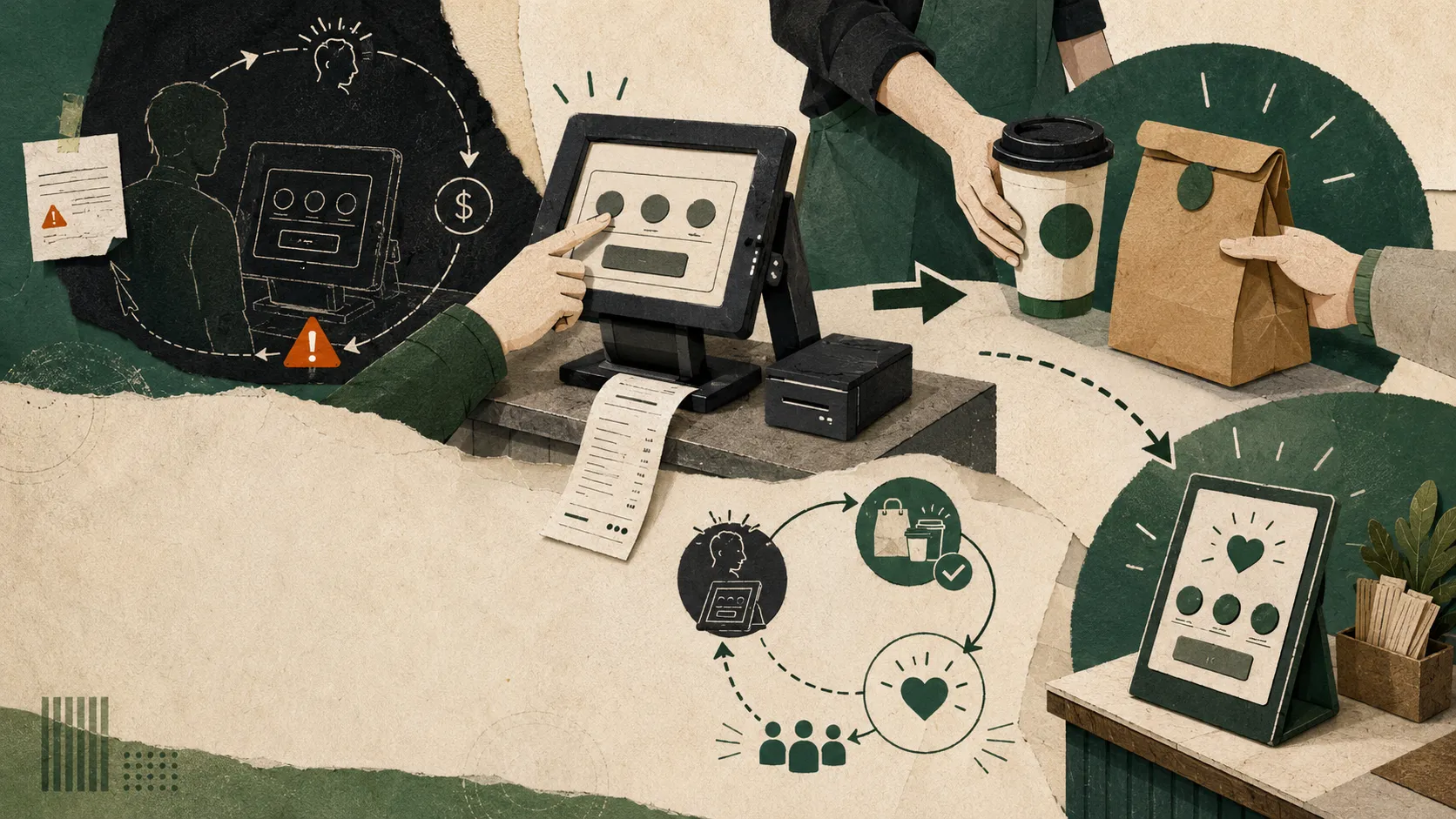
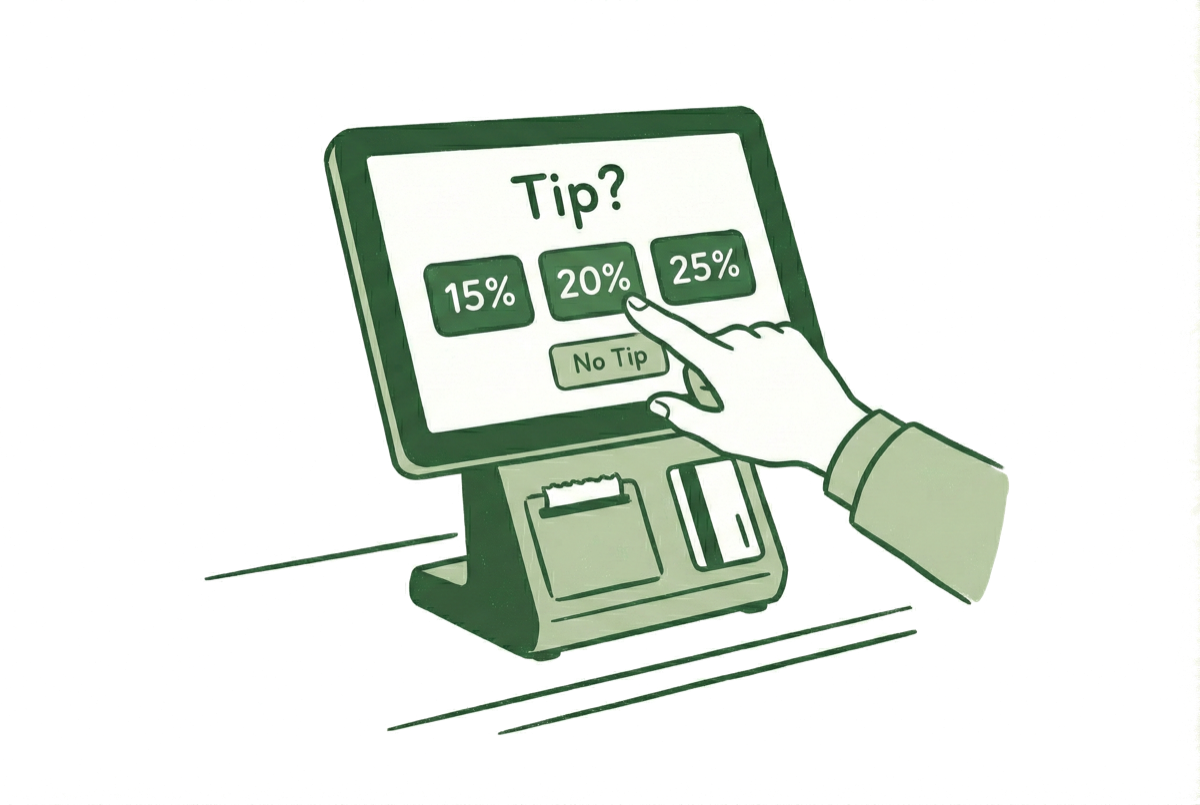
In grab-and-go contexts, the tip prompt appears before the customer receives meaningful service. The screen gives little context about who benefits, how tips affect wages, or why this moment matters. Customers feel watched, staff depend on the income, and POS vendors profit from the friction. The design challenge was to shift tipping from a pressured checkout decision into a clearer service relationship. 在「拿了就走」的场景里,小费提示通常出现在服务真正发生之前。屏幕没有解释这笔钱给了谁、如何影响员工收入、为什么这一刻值得给。顾客觉得被看着,员工依赖这部分收入,POS 系统供应商也从这种摩擦里获益。设计挑战是:怎样把小费从一个有压力的结账选择,转成更清楚的服务关系。
Key Findings核心发现
Social Visibility > Amount 社交可见性 > 金额
Tipping behavior is driven more by who is watching than by what feels fair. The observer effect at checkout inflates pressure. 给小费这件事,更多是被「谁在看着」推动的,不是「给多少才合理」。结账时的被观察效应把压力放大了。
Context > Tradition 情境 > 传统
Pre-service tipping feels illogical to customers. Context of the moment overrides cultural norms about generosity. 服务还没开始就先给小费,对顾客来说是不合逻辑的。这一刻的情境压过了关于慷慨的文化惯性。
Team Logic > Individual Attribution 团队逻辑 > 个人归属
Customers struggle to connect their tip to a specific person. Team-based framing resonates more than individual attribution. 顾客很难把自己的小费和某一个具体的人对应上。以团队为单位去讲,比对到个人更让人买账。
Income Stability > Emotional Comfort 收入稳定 > 情绪安慰
Staff prioritize consistent income over feel-good moments. Rewards systems drive revisit intent more than tip amount. 员工更在意稳定收入,不是那一瞬间的好感。奖励机制对回访率的影响,比小费金额本身更大。
Why pre-service tipping is the wrong question
Tipping used to happen at the end of a meal, after service was delivered and a bond had formed. Grab-and-go flipped that. Now the screen turns around before the cup leaves the counter, and you’re asked to reward a service that hasn’t happened yet. The tip prompt has outrun the interaction it was designed to reward.
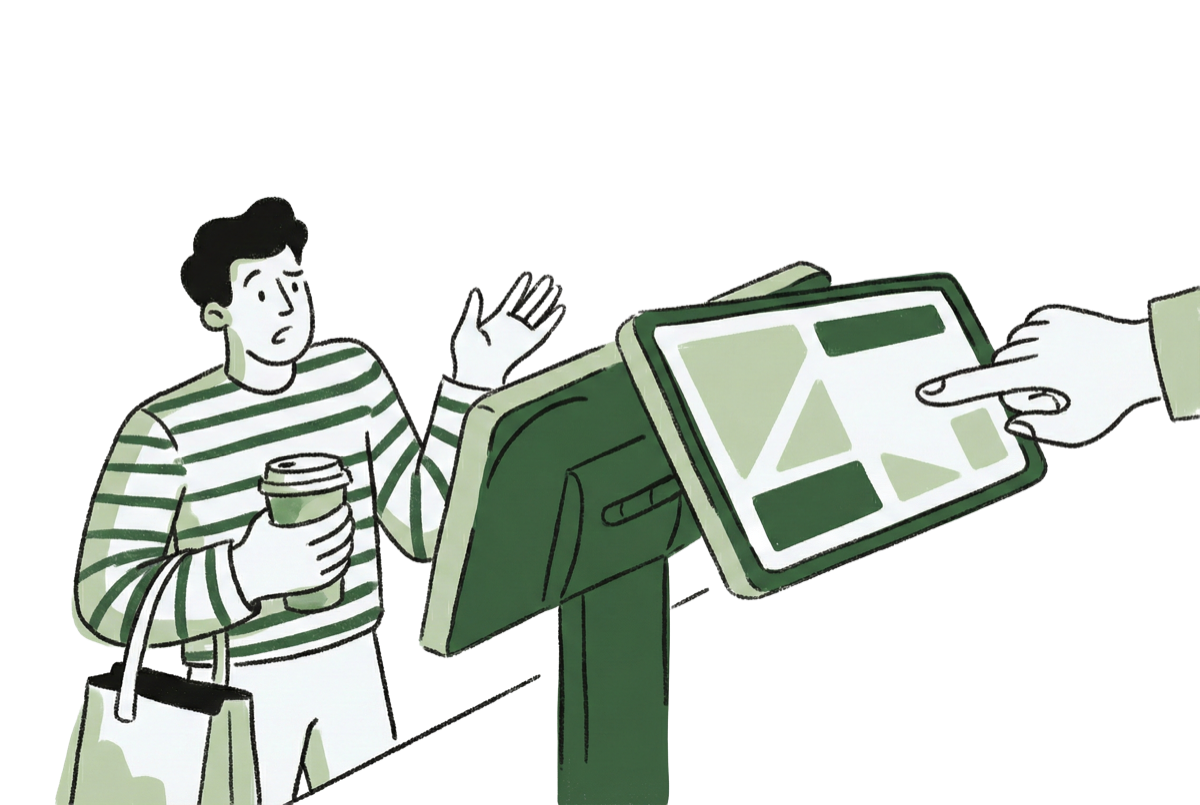
Every actor in that moment is playing a losing role. Customers pick a number under social pressure. Baristas watch tips fluctuate with no control over prompts or defaults. Owners watch regulars thin out as tip fatigue sets in. POS vendors keep tuning the screen to extract more, not to retain anyone. Nobody involved thinks the current system is good, but each piece of it is optimized for a metric that isn’t long-term loyalty.
Tipology starts from that gap. Not “how do we make people tip more,” but “what should this moment actually be doing.”
Four stakeholders, one broken contract
The first research pass was about mapping who shows up at the counter and what each of them actually wants. Four actors, four incentives, and a lot of friction where they meet.

"Why am I tipping before I get anything?"
Facing a prompt they didn't expect, in a room full of people watching.
Needs: autonomy, context, and an exit that doesn't feel rude.
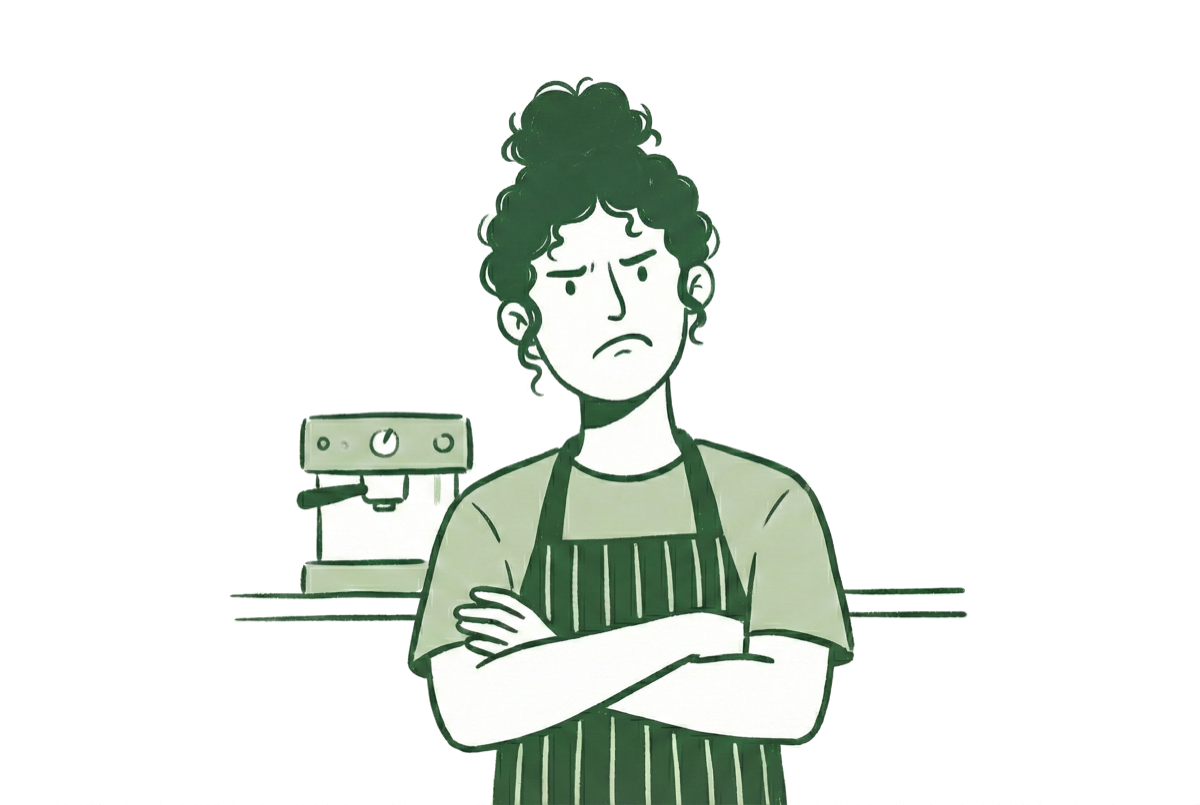
"I don't control the screen. I just live with what it does."
Income depends on prompts they didn't design and customers don't understand.
Needs: stable base pay, fewer awkward interactions at handoff.

"Higher tips today, fewer regulars next month."
Caught between the POS vendor's upsell defaults and the regulars walking away.
Needs: retention data, not just transaction data.
"Success is measured in tip volume, not return visits."
The actor with the most control over the prompt, rewarded for extraction.
Needs: a success metric that includes what happens after checkout.
The responsibility gap
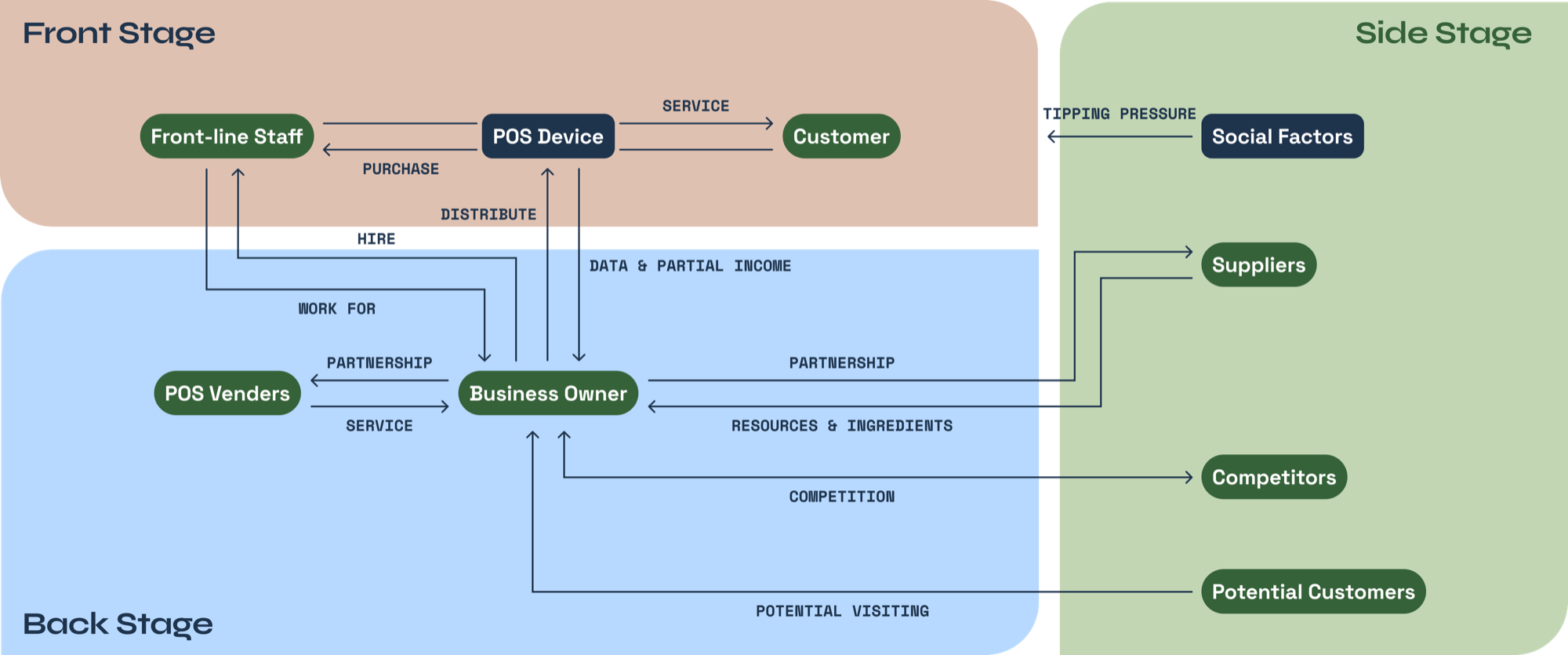
The service blueprint made the structural problem obvious. Front stage is clean (order, pay, receive). Back stage is a chain of tech decisions (prompt defaults, screen copy, distribution logic) that nobody at the counter made. The customer gets asked to make a meaning-laden decision on top of a system that gives them no meaning to work with.
Front stage and back stage don't meet in the middle. The prompt sits in the gap: visible to the customer, authored by the vendor, cashed out by the owner.
The ecosystem, and what money actually does in it
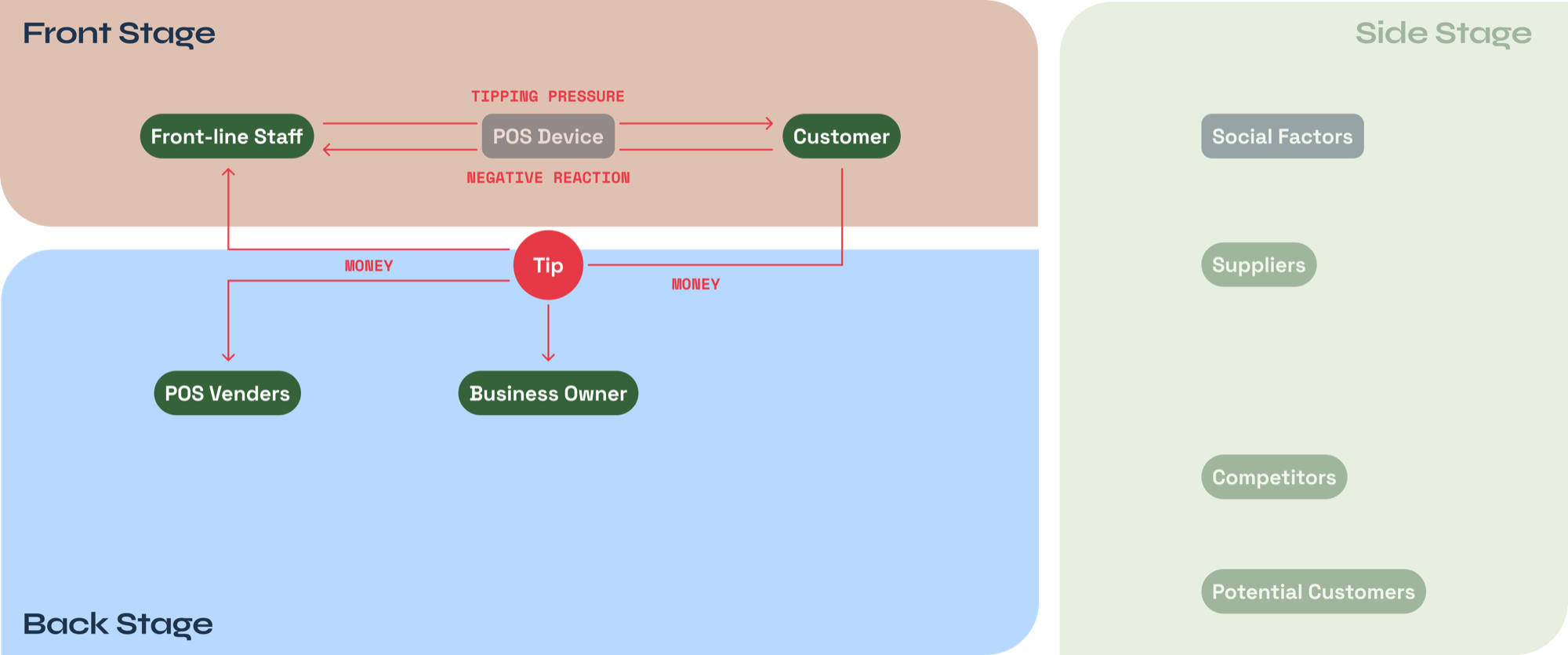
Mapping the actors is only half the picture. The other half is following the tip itself: where it enters the system, where it lands, and what it leaves behind on the way. Hover the map (or tap on mobile) to switch from the full ecosystem view to the tip-flow view.
The system, and where it can be rewired
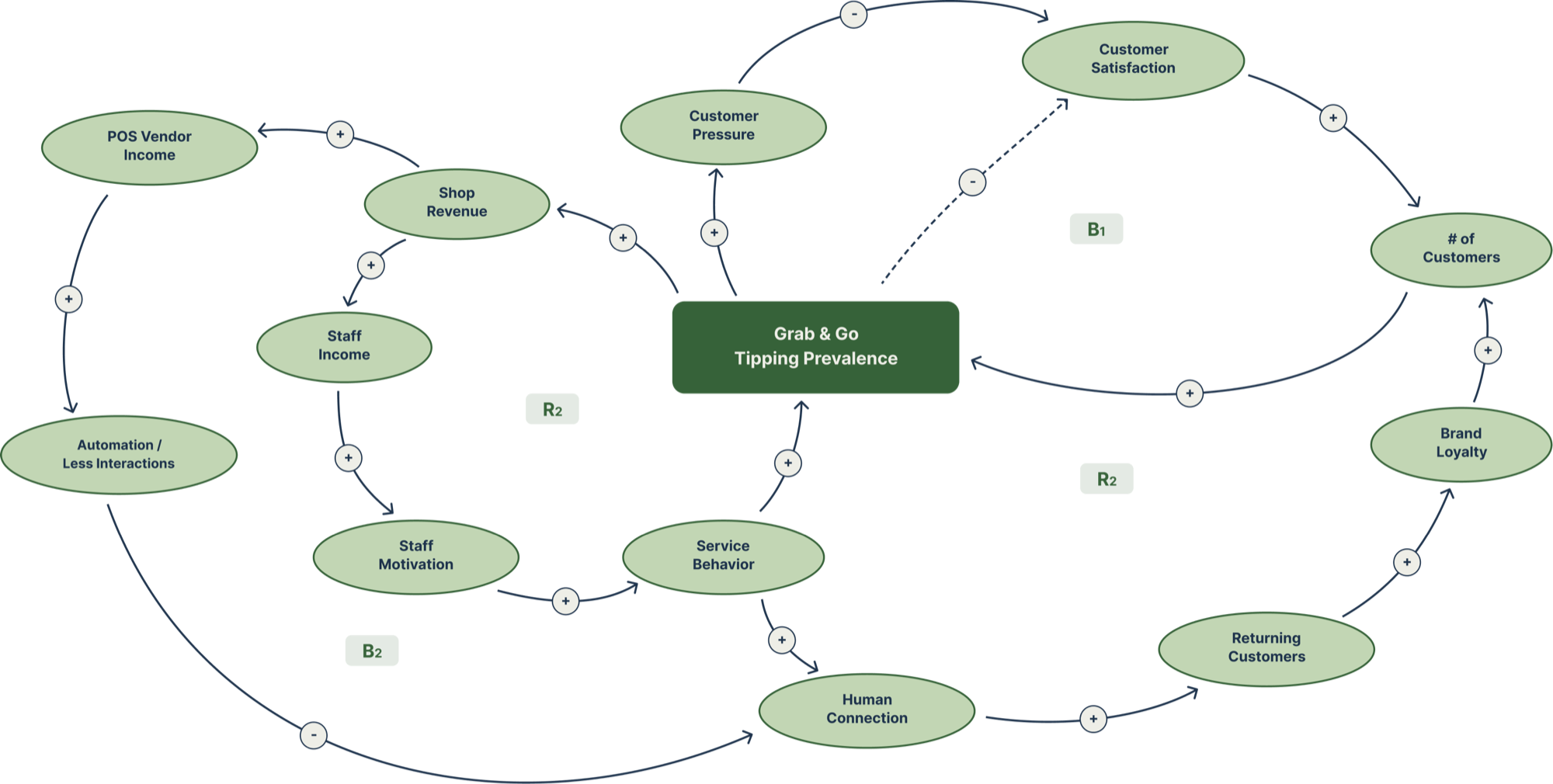
Mapping the grab-and-go tipping loop surfaced three loops interlocking in the wrong direction. B1 (social pressure) and R2 (default creep) reinforce extraction. B2 (customer fatigue) slowly drains regulars out of the system. Nothing in the current loop rewards retention, so the whole thing keeps optimizing for the short tip spike. That is exactly why long-term LTV trends down while tip totals trend up.
The same map doubles as a leverage diagram. Each of the three loops has one node where a small push can flip its direction, and one more node upstream of all three where vendor success metrics get authored. Four leverage points total, one per layer of the eventual intervention.
Co-creation: testing where intervention lands
With the system mapped, the team ran a workshop with customers and service staff to stress-test possible interventions. Two station cards carried the weight of the session: The Honest Receipt (showing where a tip actually goes) and The Invisible Flow (removing the tip prompt from the checkout moment entirely). Participants sorted them against pain points and ranked which changes they’d actually welcome.
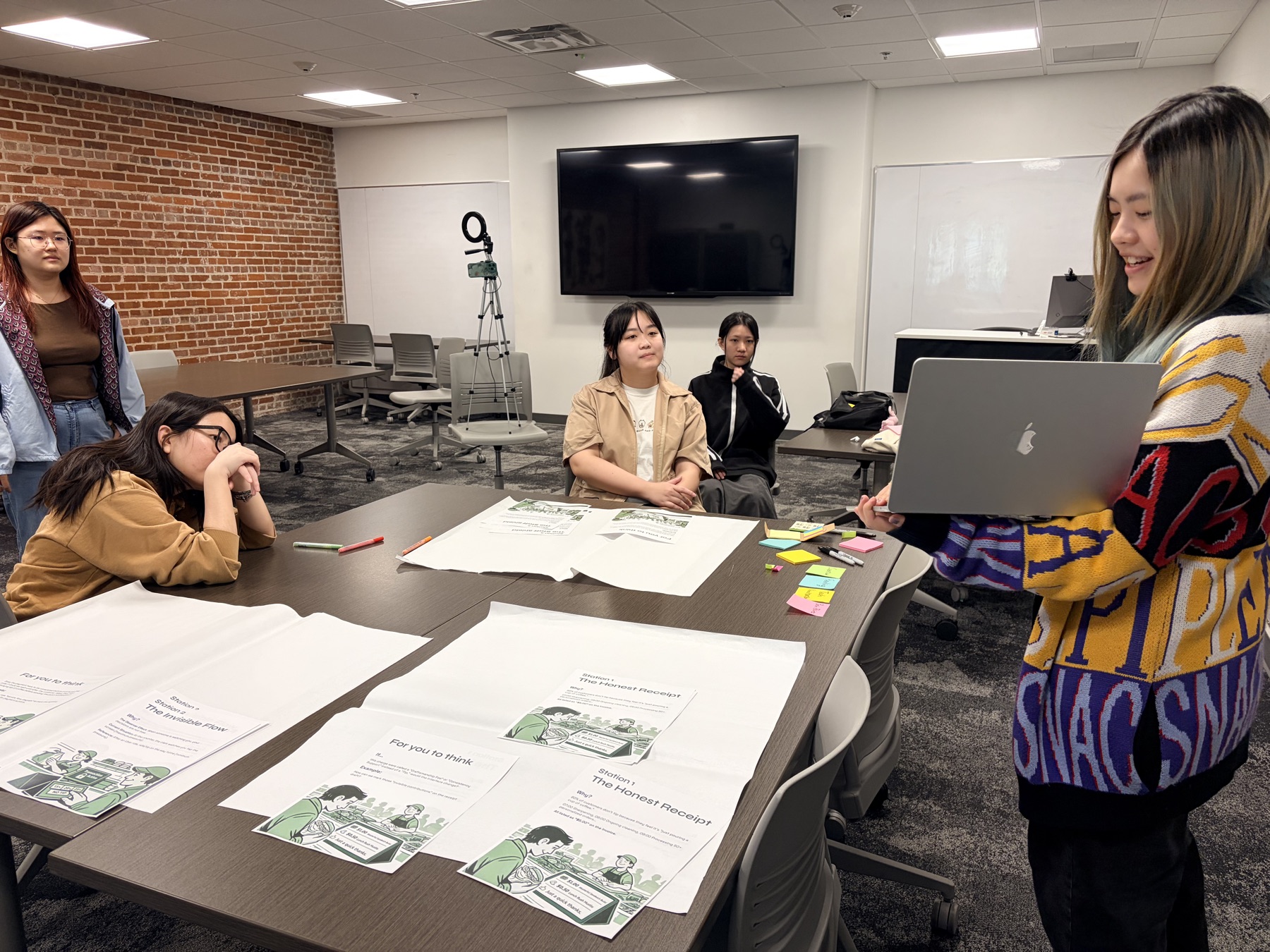
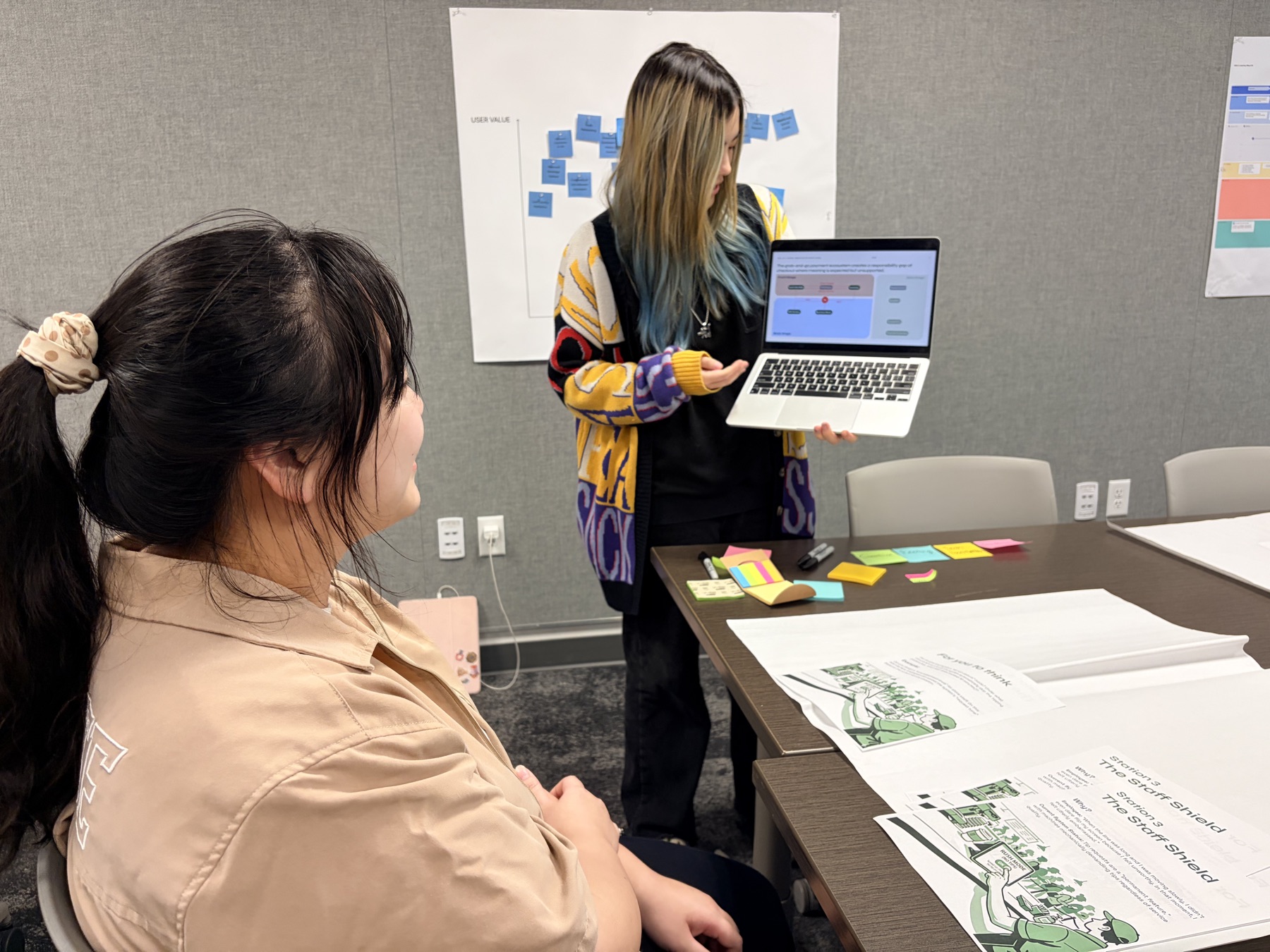
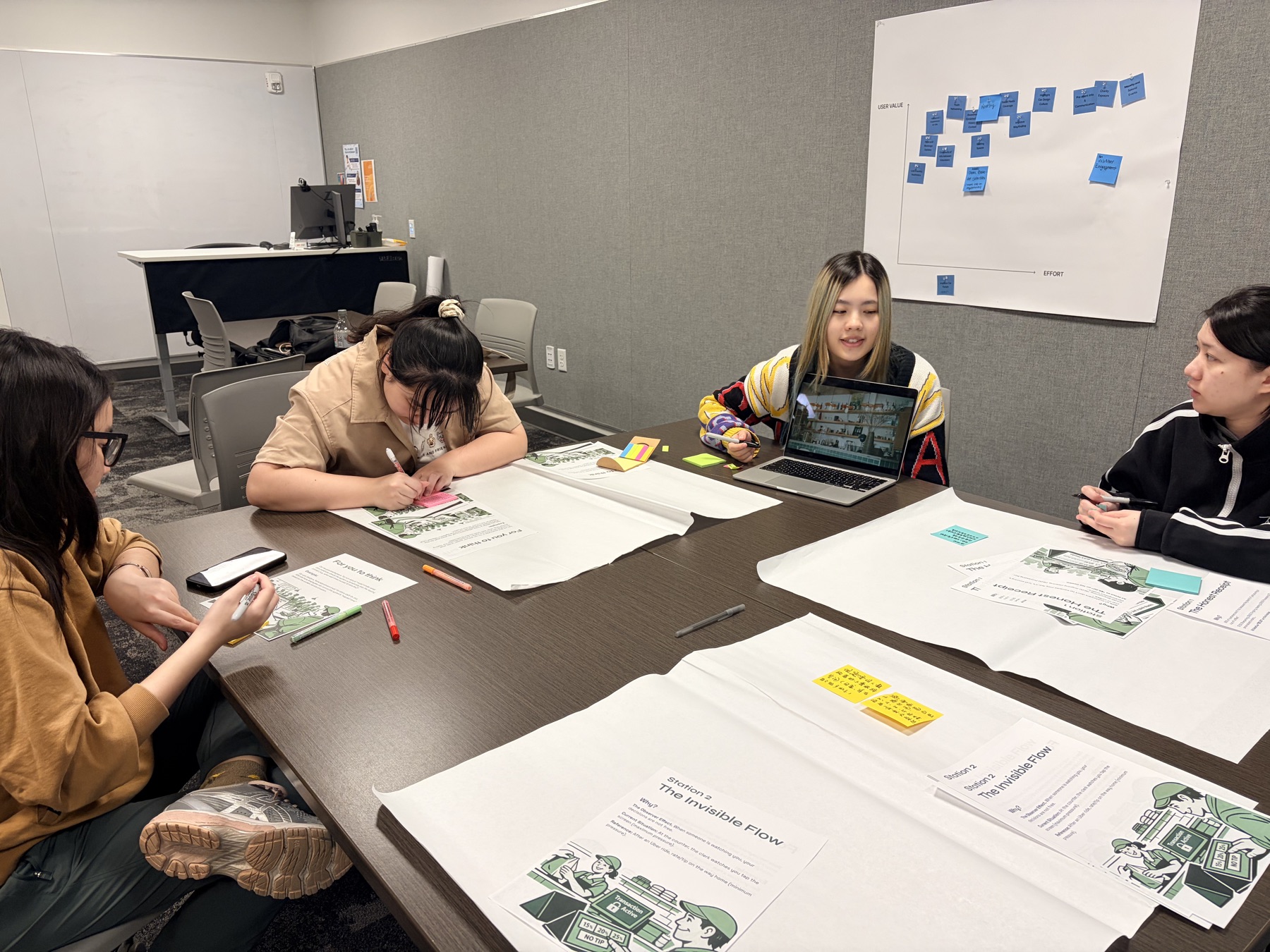
The invisible-flow frame won, but with a caveat the team took seriously: stripping the prompt out entirely risked stripping the gratitude out with it. That caveat shaped the next round.
Prototype: a grab-and-go counter, rebuilt
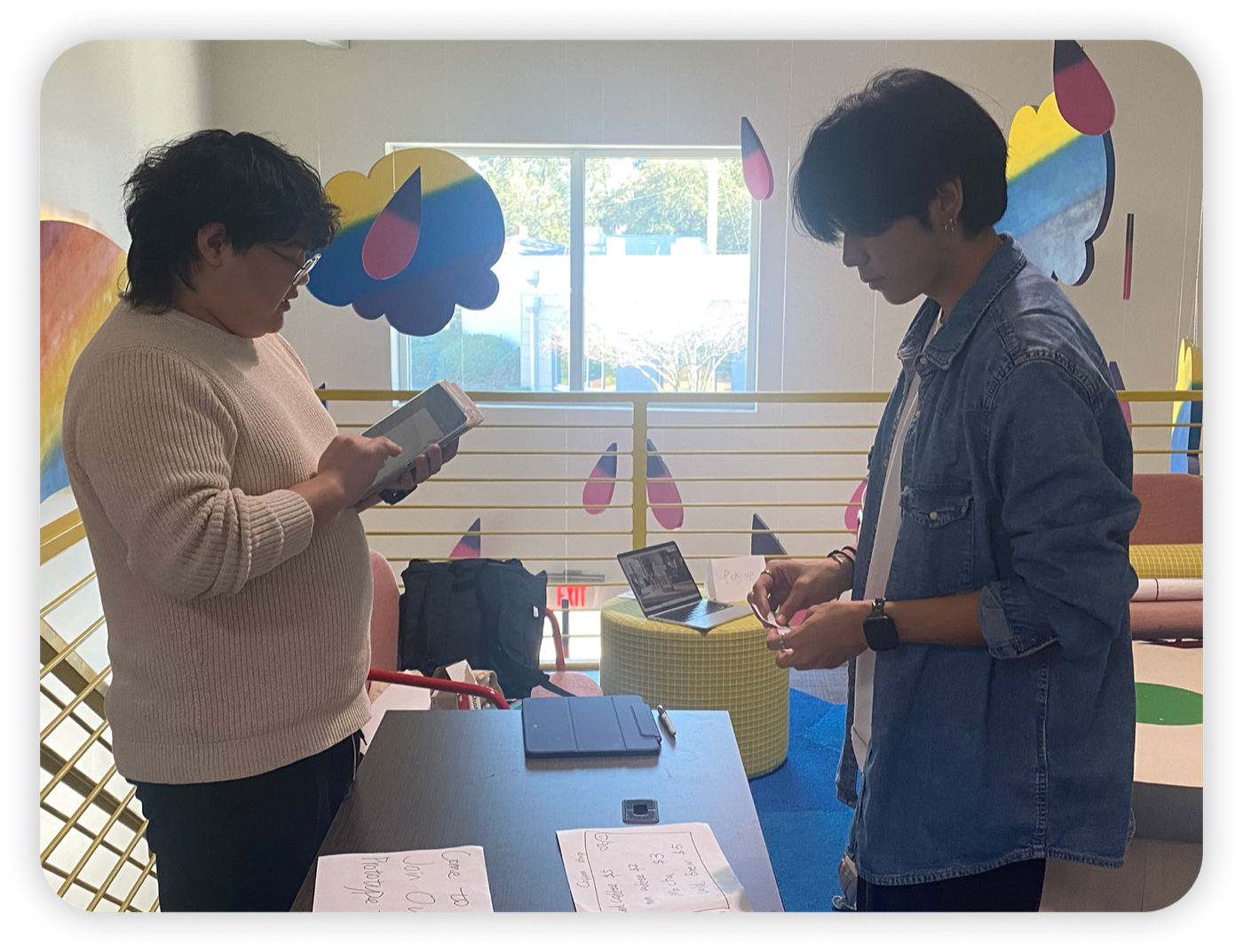
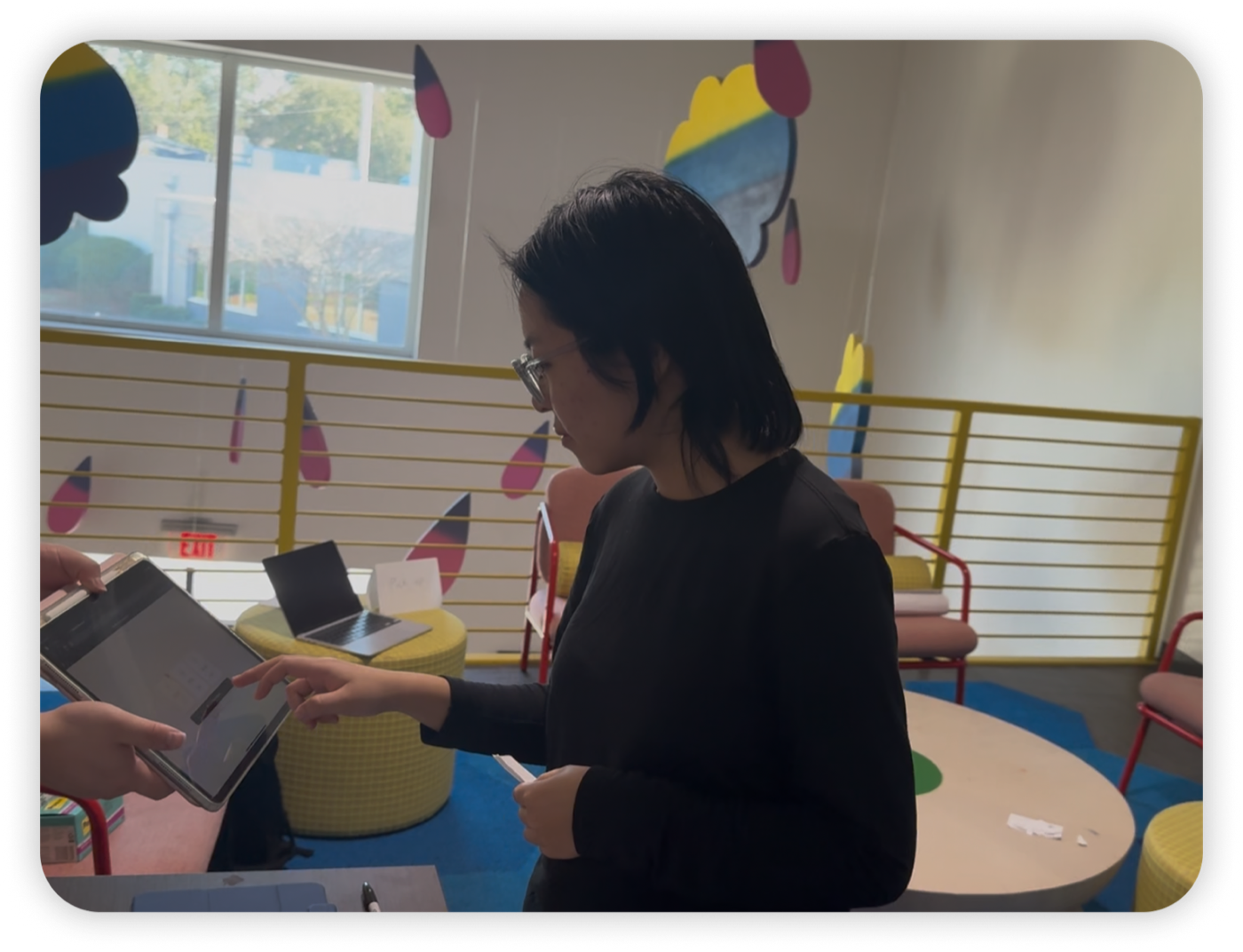
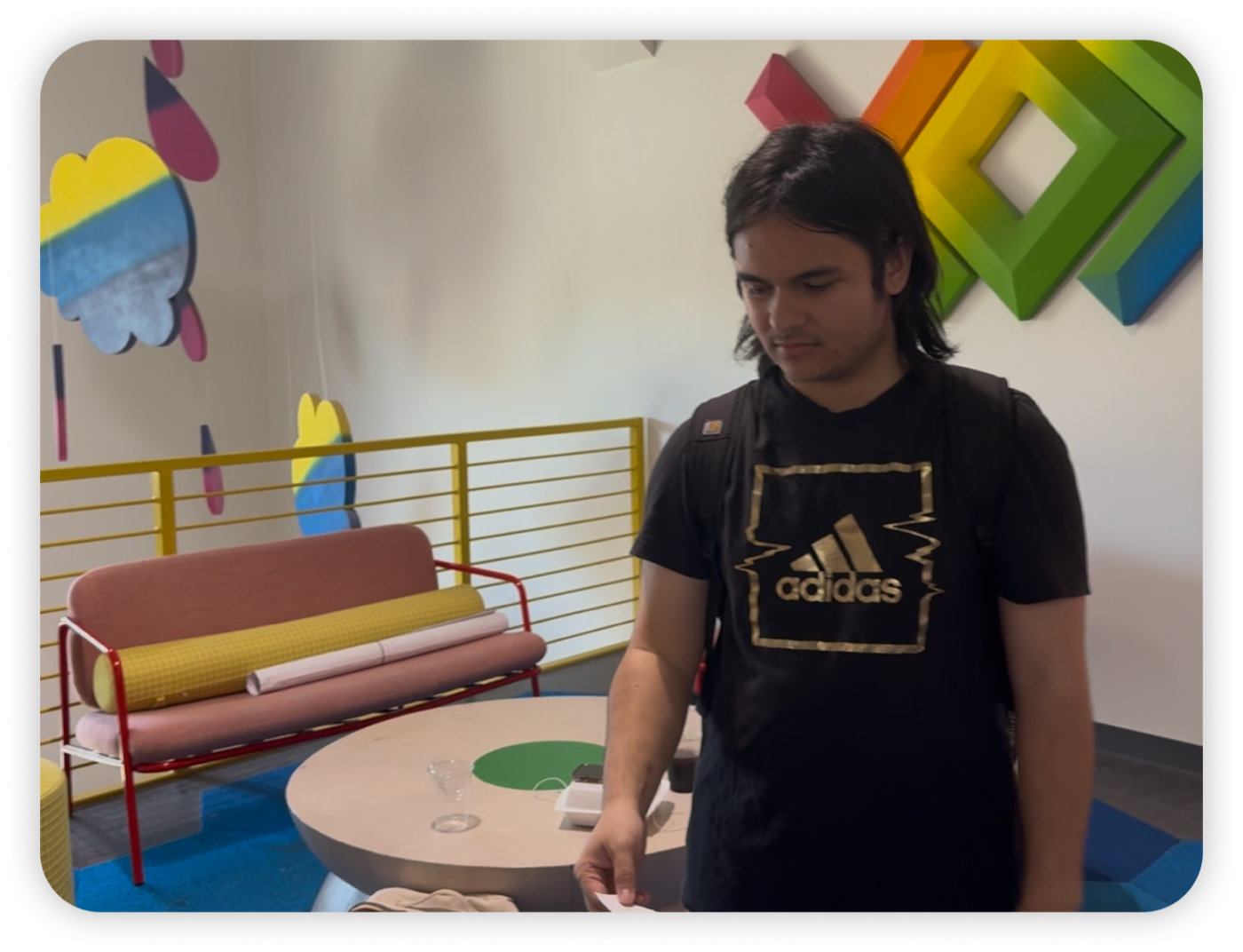
We reconstructed a counter at the SCAD Shed and tested two flows back-to-back with five participants. The first flow replaced the default tip prompt with a rewards-program welcome screen for recognized regulars. The second flow removed the prompt from checkout entirely and moved tipping to a post-service station at the pickup counter.
What the KPIs actually moved
Each participant walked through both flows, and we scored five KPIs per run against a baseline of the current grab-and-go default. The pattern was clear enough that it didn’t need averages to read: pressure collapsed, autonomy jumped, and fairness rose on the post-service flow. Efficiency dipped slightly (an extra step at pickup), but every participant still preferred it.
| KPI | P1 | P2 | P3 | P4 | P5 |
|---|---|---|---|---|---|
| Pressure | Low | Low | Low | Low | Low |
| Autonomy | High | High | Med | High | Med |
| Fairness | High | Med | Med | High | High |
| Efficiency | Med | Med | Low | Med | Med |
| LTV / Revisit | High | High | Med | High | High |
High Med Low
The risk the data almost hid
The numbers looked good. The sentiment was messier. One participant (P3) put it bluntly, and the team treated it as the most important finding of the round.
"Standing in front of a QR code means nothing to me. You took the awkward part out, but you also took the human part out."
P3, post-service flow
Removing the prompt solves one problem and creates another. If the service layer is just “skip it,” the moment becomes frictionless but hollow, and tipping decays into a task nobody feels anything about. That’s worse than the current system, not better. The four-layer framework is the team’s answer to that risk: decouple the timing without decoupling the meaning.
Four layers, one system
Each layer of Tip on Your Terms pairs a screen-level change with a physical or structural one, so the intervention never collapses back into “just remove the prompt.” The four leverage points from the loop map get one layer each, stacked from the customer surface down to the vendor contract.
Relationship Accumulation
Turns one-off pressure into two-way rewards. Protects regulars from tip fatigue and shifts tipping into a long-term relationship, not a per-visit tax.
Silence Mode: POS welcome screen skips the prompt for recognized regulars.
Community Points: post-visit notification converts tips into collective team goals.
Meaning Injection
Rebuilds the human connection the digital handoff erases. Gives the tip a recipient and a purpose instead of a percentage.
Backstage Hero: QR at pickup links to the staff page with name and "Micro-Wishes."
Itemized Tips: a transparent breakdown of where the tip actually lands.
Timing Reset
Removes the observer effect. Separates the moment of payment from the moment of gratitude so social pressure can't masquerade as generosity.
Bypass POS: minimalist checkout showing only the base price, no tip prompt.
Gratitude Wall: QR tipping station at pickup, private and opt-in.
Infrastructure Reconstruction
Aligns the vendor contract with long-term value. Without this layer the first three decay back to default within a year of rollout.
B&B Diagnostics: dashboard tracking how prompts affect return rates, not just tip volume.
Retention Success Fee: new POS pricing model tied to customer lifetime value.
With these four running together, B1 and R2 lose their fuel, B2 softens as retention rewards kick in, and the prompt stops being the main event of the transaction.
Roadmap: not a product, a sequence
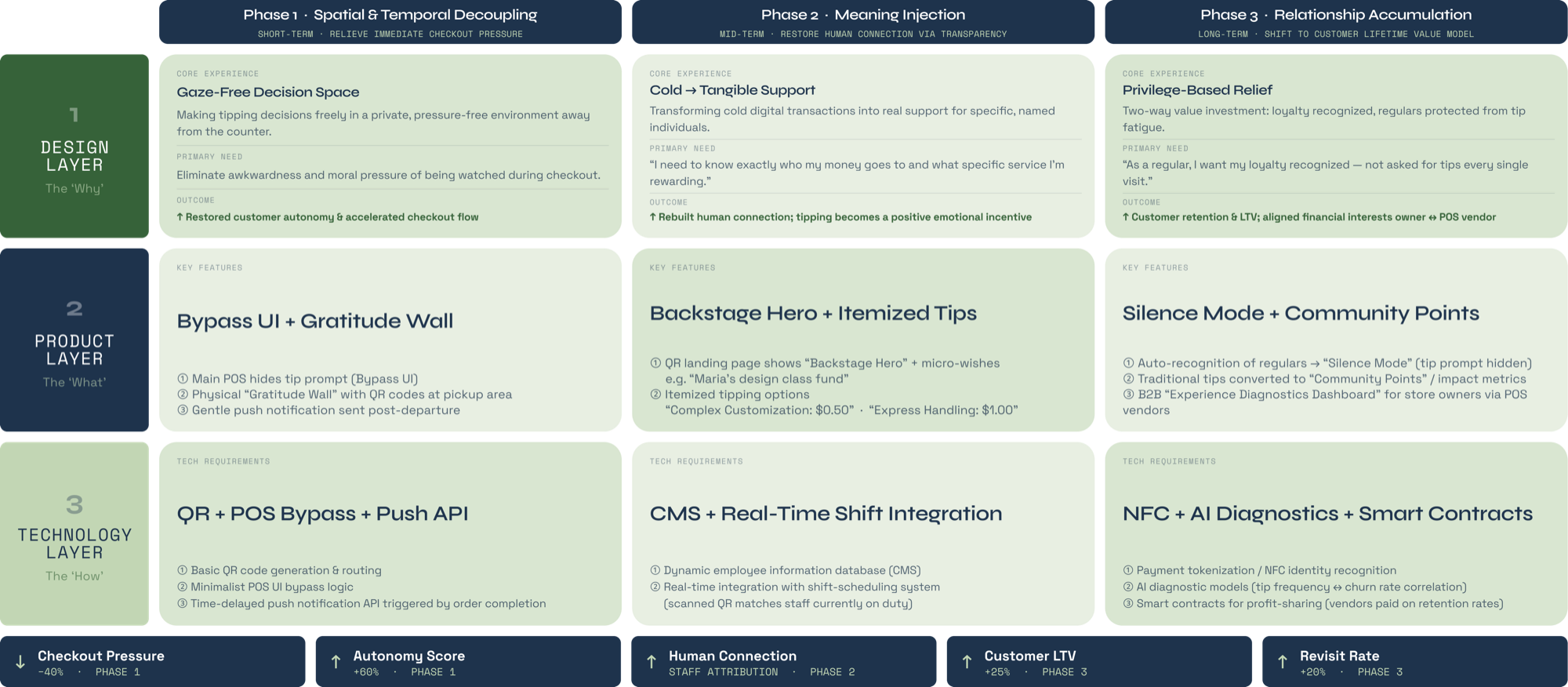
No business is going to adopt all four layers on day one. The roadmap sequences them across three phases (pilot, expand, embed) and three layers (front stage, back stage, infrastructure) so owners can start with the low-friction screen changes and build toward the vendor-level success-fee shift last.
What the critique responded to
The framing won the room. Most service-design projects on this topic land on “redesign the tip prompt.” Tipology argues the prompt is a symptom of a vendor incentive structure, and the only honest intervention is to rewire where that incentive points. The roadmap is what made it land as a service proposal instead of a screen redesign: it admits the pipe this has to travel through (owners, vendors, staff) and gives each actor a reason to move.

为什么「服务前给小费」是个错的问题
小费本来是饭吃完之后的事,服务结束、关系也建立了的那一刻才出现。「拿了就走」把这个顺序翻过来了。现在是杯子还没离开柜台,屏幕就转过来,让你给一段还没发生的服务打赏。小费提示走到了它本该奖励的那段互动前面。
那一刻里每个角色都在输。顾客在社交压力下随便选一个数字。咖啡师看着小费上下浮动,却控制不了提示和默认值。老板看着回头客一个个变少,因为小费疲劳在积累。POS 供应商还在继续调屏幕,想榨出更多,不是为了留人。没有人觉得现在这套好,但每一块都在为一个不是「长期忠诚度」的指标做优化。
Tipology 就是从这个缺口开始的。不是「怎么让人多给小费」,而是「这一刻到底该干什么」。
四个角色,一份破了的合约
第一轮研究是把柜台前这一刻的人都摆清楚:每个人到底要什么。四个角色,四套激励,相接的地方摩擦一大堆。
「我什么都还没拿到,为什么要先给小费?」
面对一个没预期的提示,屋子里还有一圈人在看。
需要:自主权,上下文,一个不让自己显得没礼貌的退出方式。
「屏幕不是我控制的。它怎么弄,我就接着怎么过。」
收入依赖的是他们没设计、顾客又看不懂的提示。
需要:稳定的底薪,交接那一刻少一点尴尬。
「今天小费高了,下个月回头客就少了。」
夹在 POS 供应商的追加默认值和走掉的老顾客中间。
需要:留存数据,不只是交易数据。
「成功是用小费总额算的,不是回访。」
最能控制这个提示的那一方,被以「榨取」作为奖励。
需要:一个把「结账之后发生什么」也算进去的成功指标。
责任真空
服务蓝图把结构问题摆得很直白。前台是干净的(点单、支付、拿走)。后台是一串柜台前没人参与的技术决定(提示默认值、屏幕文案、分配逻辑)。顾客被迫在一个不给他任何意义线索的系统上,做一个意义很重的决定。
前台和后台在中间不相接。提示就卡在这个真空里:顾客看得见,供应商写的,店主把钱收走。
生态图,以及钱在里面的流向
把角色摆清楚只是一半。另一半是跟着小费本身走:它从哪里进系统,落到哪里,沿路留下了什么。把鼠标移到地图上(手机点一下)就能从完整生态图切到资金流向图。
系统,以及它可以在哪里被重接
把「拿了就走」的小费循环画出来之后,三条循环互相咬住,方向都拧着。B1(社交压力)和 R2(默认值上浮)在放大榨取。B2(顾客疲劳)慢慢把回头客从系统里抽走。现在这套循环里没有任何一处在奖励留存,所以整个系统一直在为短期的小费峰值做优化。这也正是小费总额在涨,而长期 LTV 在掉的原因。
同一张图也是杠杆图。三条循环里每一条都有一个节点,在那里轻推一下就能把方向翻过来。再往上游还有一个节点,所有三条循环都从那里生出来,供应商的「成功」是在那里被定义的。四个杠杆点,正好对应后面干预方案的四个层级。
共创:把干预放在哪里
系统图画完后,团队找了顾客和服务员做工作坊,把可能的干预方案拉出来压力测试。场子是靠两张站卡撑起来的:诚实账单(让顾客看见小费真的去了哪)和隐形流程(把小费提示从结账这一刻彻底拿走)。参与者把卡片和痛点对上,然后排一下他们真的欢迎哪种改动。
隐形流程这个方向赢了,但团队非常认真对待它带的一个警告:把提示彻底拿走,有可能把感谢本身也一起拿走。下一轮的设计就是被这个警告推着走的。
原型:重搭一个「拿了就走」的柜台
我们在 SCAD Shed 重建了一个柜台,连着测试了两个流程,5 位参与者。第一个流程把默认的小费提示换成了给回头客看的奖励计划欢迎界面。第二个流程把提示从结账里彻底拿掉,把小费挪到取餐柜台旁边的一个「服务后」小站。
KPI 到底动了什么
每位参与者都走完两个流程。我们以现在「拿了就走」的默认值作为基线,每一轮给五个 KPI 打分。趋势很清楚,不用取均值也能读出来:压力塌下去了,自主感跳上来了,服务后那一版的公平感也上来了。效率稍微掉了一点(取餐多一步),但参与者还是一致偏好这版。
| KPI | P1 | P2 | P3 | P4 | P5 |
|---|---|---|---|---|---|
| 压力 | 低 | 低 | 低 | 低 | 低 |
| 自主感 | 高 | 高 | 中 | 高 | 中 |
| 公平感 | 高 | 中 | 中 | 高 | 高 |
| 效率 | 中 | 中 | 低 | 中 | 中 |
| LTV / 回访 | 高 | 高 | 中 | 高 | 高 |
高 中 低
差点被数据盖住的那个风险
数字好看。感受比数字要乱。一位参与者(P3)说得很直接,团队把这句话当成了这一轮最重要的发现。
「站在一个二维码前面对我来说没有任何意义。你把尴尬那一部分拿走了,但把人的那一部分也一起拿走了。」
P3,服务后流程
把提示拿掉解决了一个问题,同时造了一个新的。如果服务层就是「跳过」,这一刻会变得顺滑但空心,小费退化成一个没有人会动感情的任务。那比现在还要糟,不是更好。四层框架就是团队对这个风险的回答:把时机解耦,但不要把意义一起解耦。
四层,一套系统
Tip on Your Terms 的每一层都把一个屏幕层面的改动,和一个物理或结构上的改动配成一对,让整个干预不会又塌回「只是把提示拿掉」。循环图里的四个杠杆点各占一层,从顾客看得见的表面一路堆到供应商合约。
关系沉淀
把一次性的压力变成双向的奖励。保护老顾客不被小费疲劳耗光,把小费从每次的「税」变成长期关系里的投入。
静默模式:POS 识别到老客时,欢迎界面自动跳过提示。
社区积分:离店后推送,把小费换成整个团队的集体目标。
意义注入
把数字交接抹掉的那份人的连接补回来。给小费一个具体的收信人和一个去处,而不是一个百分比。
幕后主角:取餐处的二维码跳到员工主页,带名字和「小心愿」。
小费明细:透明拆分,这笔小费真正落到了哪里。
时机重置
拿掉被观察效应。把付款那一刻和感谢那一刻分开,让社交压力没法伪装成慷慨。
简化 POS:极简结账界面,只有基础价格,没有小费提示。
感谢墙:取餐处的二维码小站,私密、自愿。
基础设施重建
让供应商的合约和长期价值对齐。没有这一层,前三层会在上线一年内塌回默认值。
B&B 诊断仪表板:追踪提示对回访率的影响,不只是小费总额。
留存型成功费:新的 POS 定价模式,和顾客终身价值挂钩。
这四层一起跑,B1 和 R2 的燃料就被抽走了,B2 随着留存奖励开始生效慢慢缓下来,结账时的那个提示,也不再是这单交易的主角。
路线图:不是一个产品,是一段顺序
没有哪家店会第一天就把四层都接进来。路线图把它们铺在三个阶段(试点、扩展、嵌入)和三层(前台、后台、基础设施)里,让老板可以先从最低摩擦的屏幕改动开始,把供应商层面的成功费机制留到最后。
讲评里真正留下的东西
框架本身赢下了评审室。这个题目下大部分服务设计项目都会落到「重设计小费提示」上。Tipology 的主张是:提示只是一个症状,背后是供应商的激励结构,唯一诚实的干预是把激励指向的那一端重接一下。路线图让这个项目被当成一份服务提案,而不是一次屏幕改稿:它承认这件事得穿过哪些环节(店主、供应商、员工),也给每一方一个出力的理由。