Between 2019 and 2024, more than 3,200 mid-market fashion stores closed in the U.S. At the same time, shoppers priced out of luxury and tired of fast fashion are moving into the middle with conflicting expectations. This project asks which service behaviors mid-market retailers can actually afford to deliver, and which ones only perform luxury without improving loyalty. 2019 到 2024 年间,美国有超过 3,200 家中端时尚门店关闭。但另一边,买不起奢侈品、也不再信任快时尚的消费者正在回到中端,只是他们带着彼此冲突的期待。这个项目追问的是:哪些「奢侈级」服务动作是中端品牌真的跑得起、也能提升忠诚度的,哪些只是表演。
Key Findings核心发现
The Market Is Polarizing 市场在两头分化
43.3% of respondents shifted toward mid-market in the past year. 33.4% shifted outward to fast fashion and luxury. The middle is absorbing refugees from both ends who arrive with conflicting expectations. 过去一年里,43.3% 的受访者向中端迁移。33.4% 朝两头走:快时尚或奢侈品。中段在接收两端挤过来的人,而他们带着互相冲突的期待。
Accessible Excellence, Not Luxury Emulation 「做得扎实」比「模仿奢侈」管用
48.3% are willing to pay a 5 to 10 percent premium for better service, but preferred quarterly spend peaks at $201 to $300. Mid-market wins by respecting time and money, not by staging luxury. 48.3% 愿意为更好的服务多付 5–10% 的溢价,但季度偏好支出峰值在 $201 到 $300 之间。中端赢在尊重时间和钱,不在演一场奢侈。
Essentials Outrank Extras 基础胜过花样
Free shipping, birthday offers, and points outperform personal styling and member-only events across every segment. Practical beats experiential. 免运、生日礼遇、积分,每一个人群里都跑赢私人搭配和会员活动。实用的赢过体验的。
The Fitting Room Is the Conversion Point 试衣间才是转化点
On Emma's journey the fitting room is the lowest emotional moment and the place the purchase decision is made. It is also the most underdeveloped touch-point in mid-market retail. 在 Emma 的旅程里,试衣间既是情绪最低点,也是购买决定真正发生的地方。同时它也是中端零售投入最少的那一个触点。
The middle is crowded, not empty
Mid-market fashion is the category nobody roots for. Luxury has its mystique. Fast fashion has its economics. The middle has Banana Republic, J.Crew, Madewell, Coach, Lululemon, and an accounting problem.
The operating assumption going in was the easy one. Mid-market is dying because consumers abandoned it. The survey told the opposite story.
43.3% shifted toward mid-market
- 43.3% shifted toward mid-market
- 33.4% shifted to fast fashion or luxury
- 21.7% maintained their habits
The middle is not stagnant. It is being re-populated, mostly by shoppers priced out of luxury who arrive with luxury-grade expectations for service and sub-luxury tolerance for price.
What the 48.3% actually want
There is a premium to capture, but it is narrow. And it is earmarked for reliability, not for staged luxury.
The premium is narrow and earmarked
A 15 percent operational bet lands on the wrong side of this number. Anything requiring a bigger markup to sustain is out of scope. The quarterly spend window tells the same story.
Preferred quarterly spend to maintain enhanced membership
Membership benefits should tier against an $800 to $1,200 annual floor. Lower looks cheap. Higher locks out the target segment.
Essentials outrank extras
Ask customers to forced-rank service attributes and the hierarchy is consistent. Operational quality at the top, luxury signaling at the bottom.
Service attribute average rating (1–5)
Luxury touch-points that signal status but slow the transaction score as a negative. Reliability wins.
Membership benefits ranked by average rating
The benefits luxury uses to signal membership (stylists, events) rank lowest. The benefits that cost the least operationally rank highest. The cheapest program to run is also the most wanted.
"Accessible excellence. Reliable, efficient, quality-focused retail that respects both the customer's time and money."
Research thesis · synthesized from 130 insights
Three interviews, one argument
Three angles, one conclusion. Authentic beats scripted, unobtrusive beats attentive, and changing-room quality is a non-negotiable.
"Loyal customers become family."
Sees membership as the glue. Believes service should be personal regardless of traffic. Sweet spot: non-pushy personalized service. Pain: balancing attention at peak hours.
"I just want to find my size and leave."
Values streamlined flow and well-designed fitting rooms. Unsubscribes from any program that spams. Sweet spot: privacy and efficiency. Pain: hovering staff, curtain fitting rooms.
"Help should be a button, not a person."
Appreciates styling help when asked for. Asked directly for a fitting-room service bell. Sweet spot: available but silent service. Pain: pushy or discriminatory behavior.
Banana Republic vs. Lululemon, one block apart
Broughton Street in Savannah has both stores a hundred yards apart. Observing them back-to-back made the service-strategy contrast legible.
Traditional Retail
Atmosphere: minimalist, elegant, ambient music, comfortable rest areas. Staff: engaged on interest, non-intrusive. Membership: promoted at checkout only. Flow: 10 to 20 minute browse, high conversion, clear staff–customer boundaries.
Community Model
Atmosphere: dense merchandising, upbeat music, industrial-warm palette. Staff: conversational, blurred boundaries. Membership: ambassador-program displays, lifestyle-first messaging. Flow: dedicated fitting-room staff, 30-day trial, out-of-stock home delivery.
Both convert. Neither is wrong. The takeaway is that mid-market has two defensible positions against fast fashion and luxury (operational excellence or community ownership), and the brand has to pick one. Running a diluted version of both produces a store that feels generic.
Meet Emma
Emma is 28, a marketing coordinator. She shifted out of fast fashion last year, researches online before going in, and calculates cost-per-wear in her head. Her line is the whole study in one sentence.
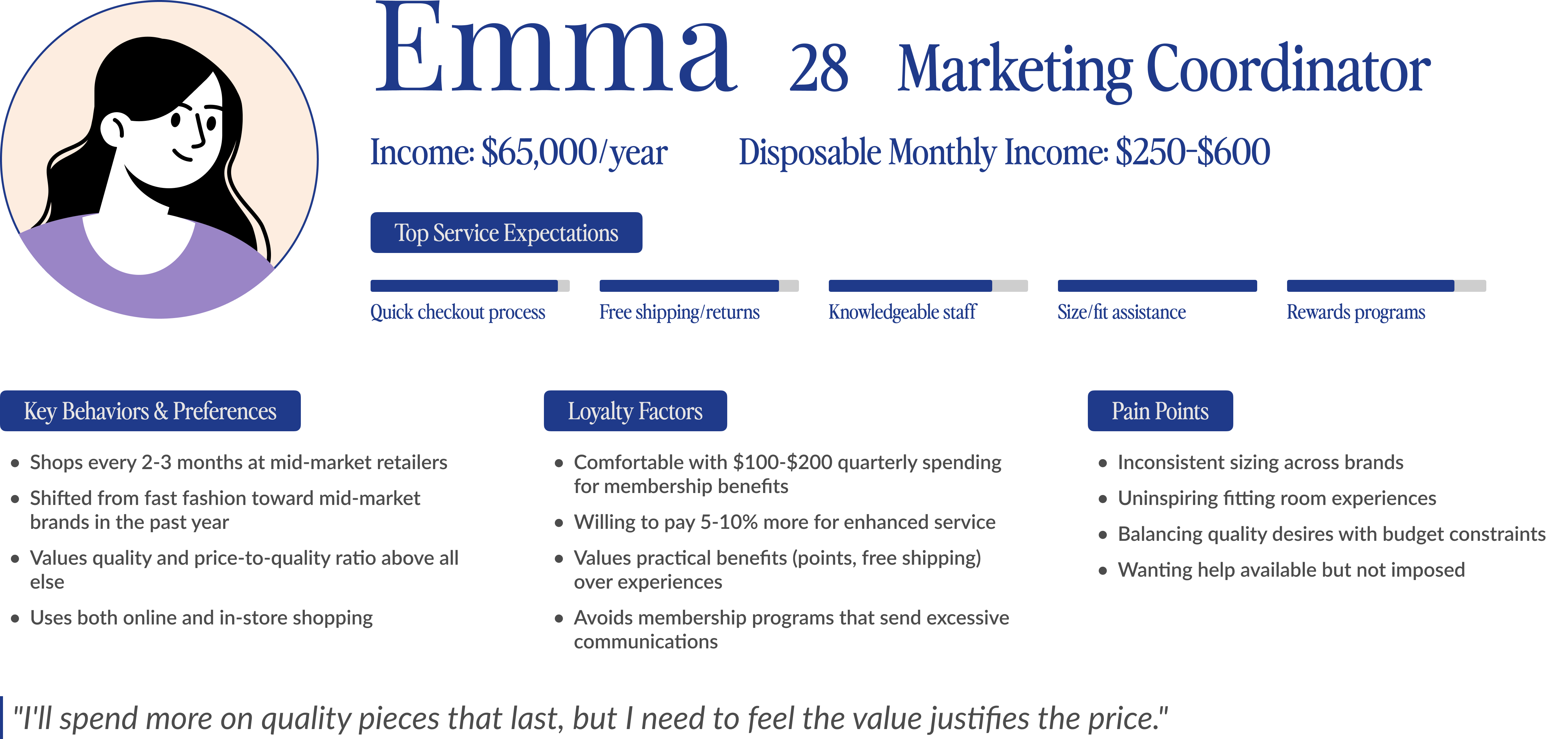
"I'll spend more on quality pieces that last, but I need to feel the value justifies the price."
Emma · representative persona
The fitting room is the decision point
Mapping Emma’s journey across Research → Store Visit → Try-On → Purchase → Post-Purchase produced one non-obvious finding. Her emotional low point is the fitting room, not the purchase.
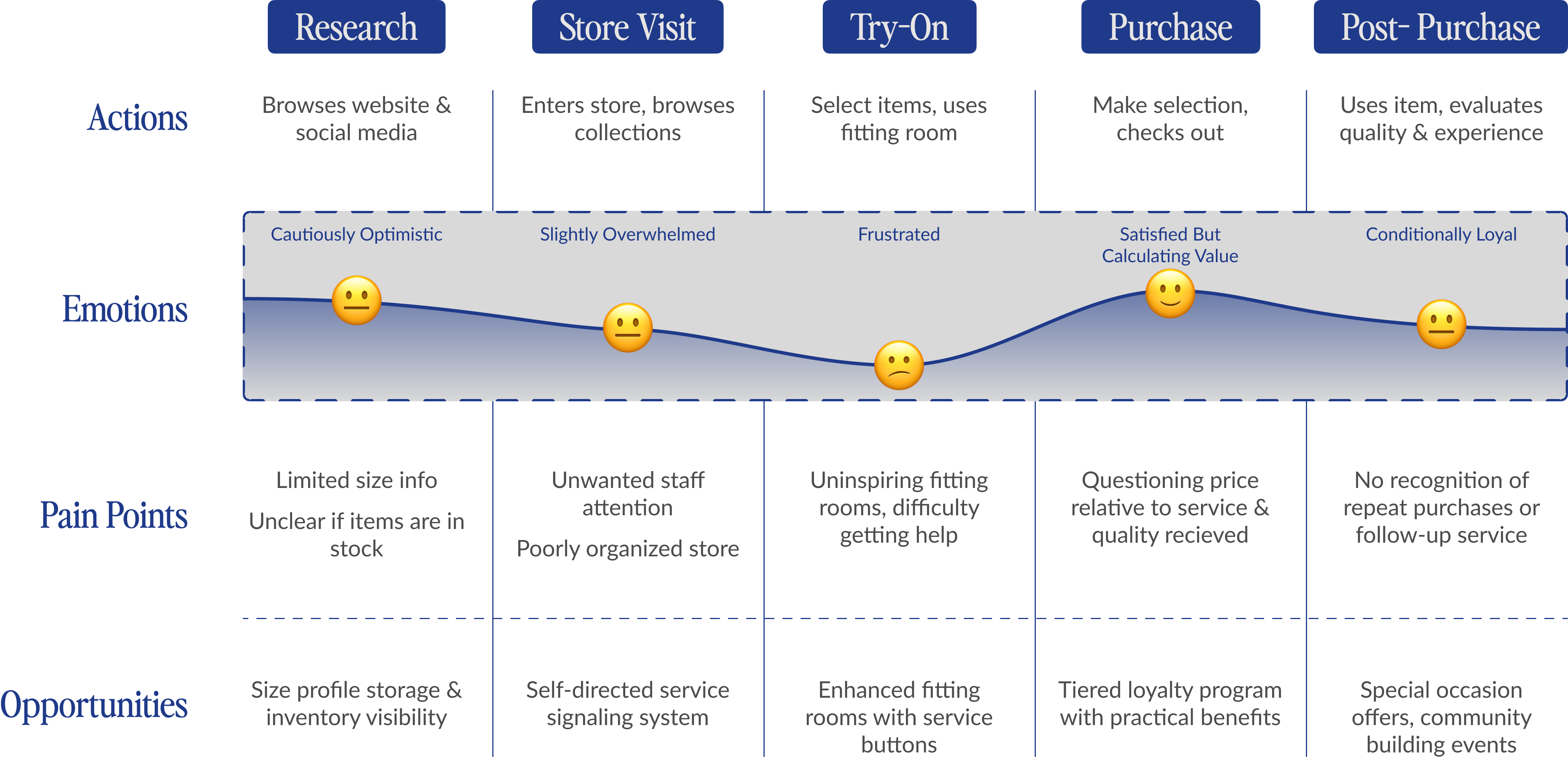
The fitting room is where the purchase decision is actually made and where mid-market has invested the least. Curtains instead of doors. No way to ask for a different size without getting dressed again. No feedback channel for the staff member who would be helpful at the right moment. The rest of the store can be excellent and a bad fitting room will still lose the sale.
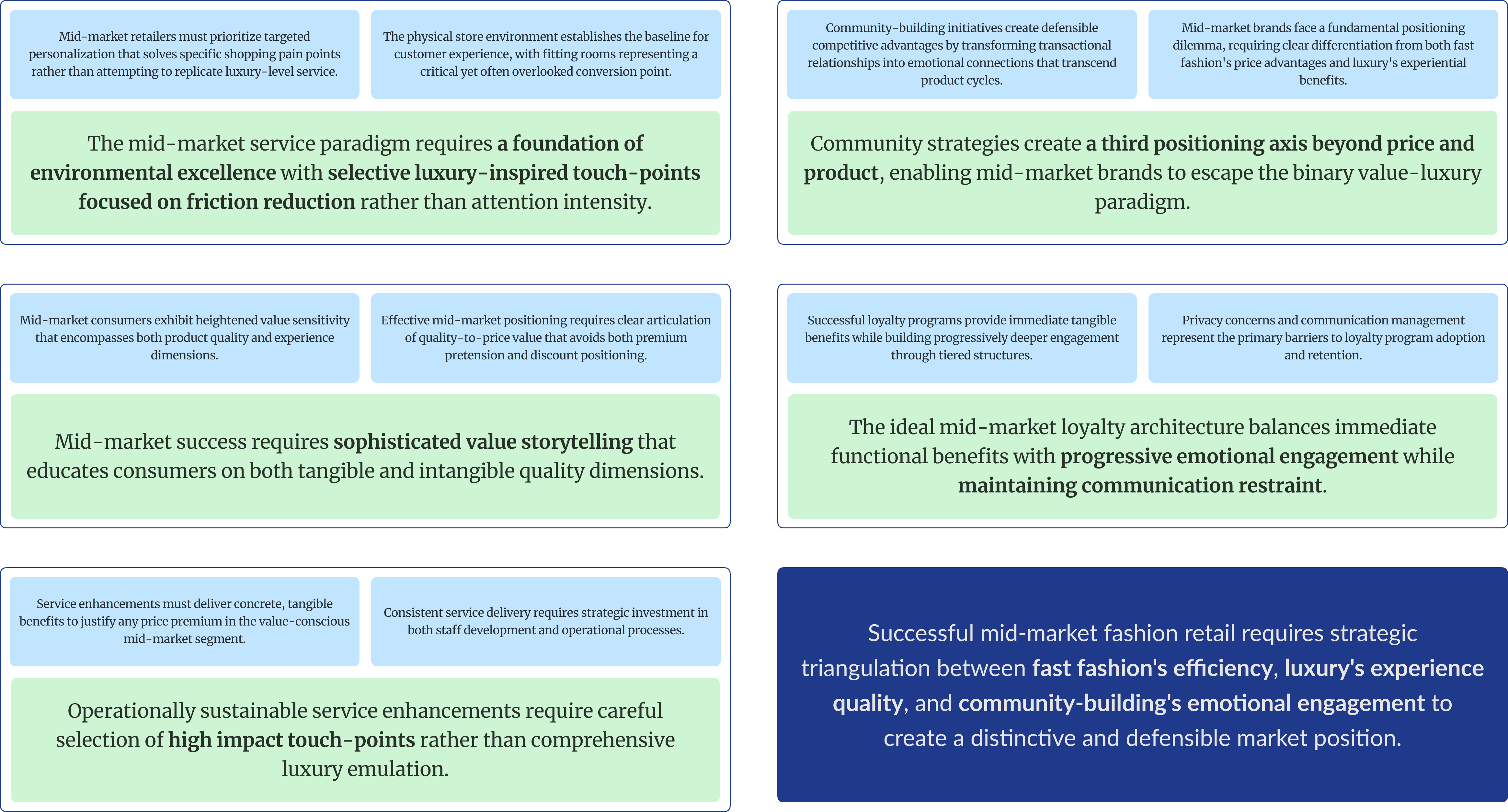
130 insights, twelve clusters, five bets
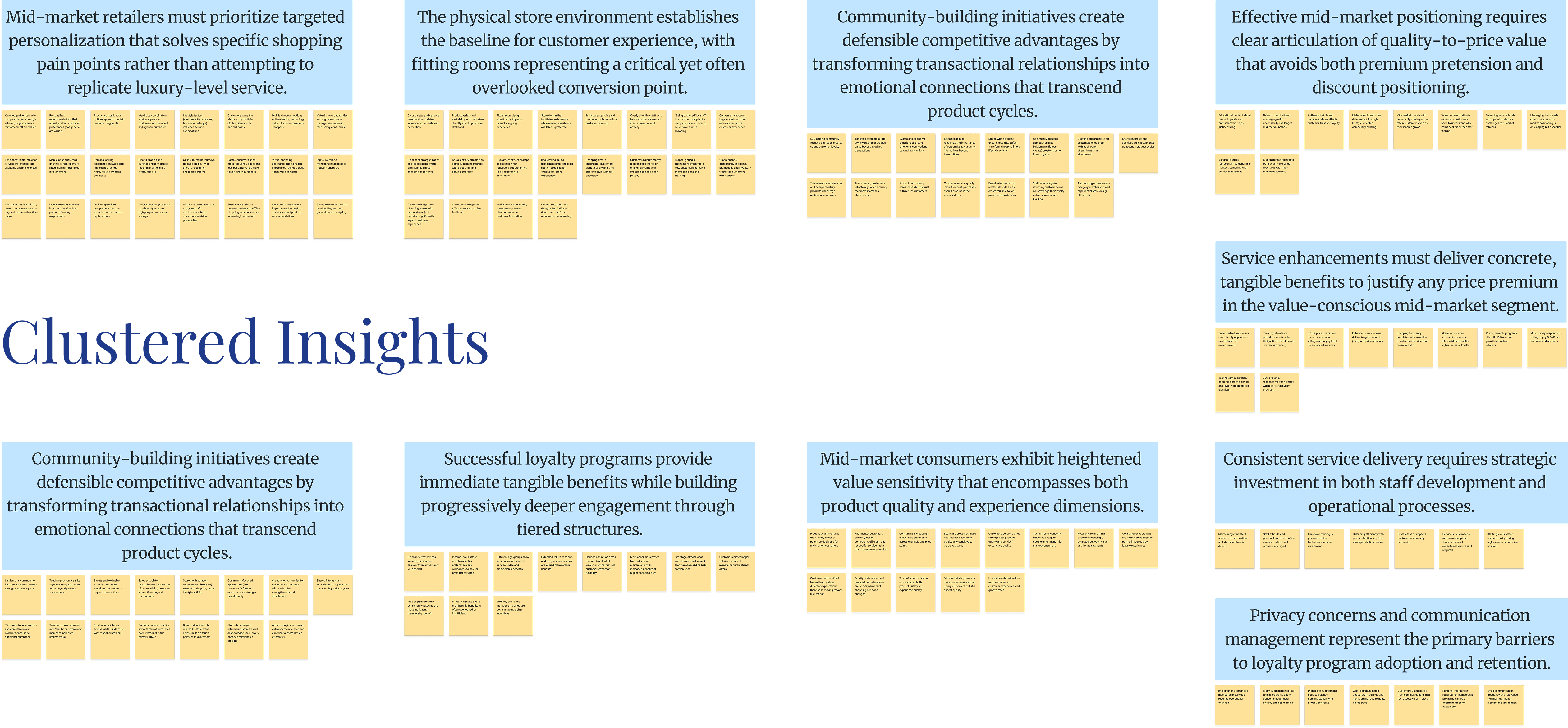
Two weeks of affinitization pulled survey open-responses, interview quotes, and observation notes into a shared grammar.
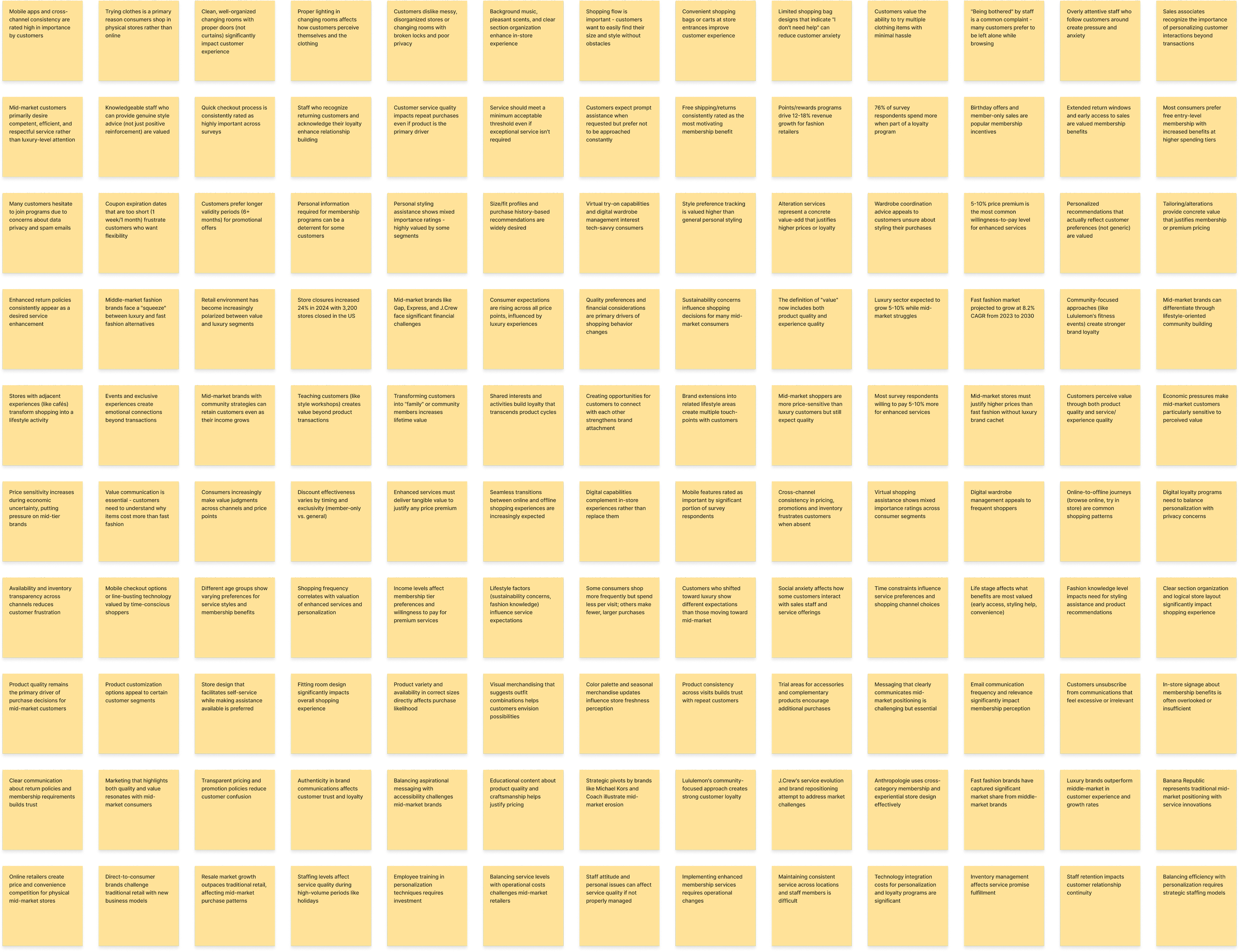
Five places mid-market can spend the premium
The five design opportunities translate 130 insights into places the 5 to 10 percent premium can be credibly reinvested.
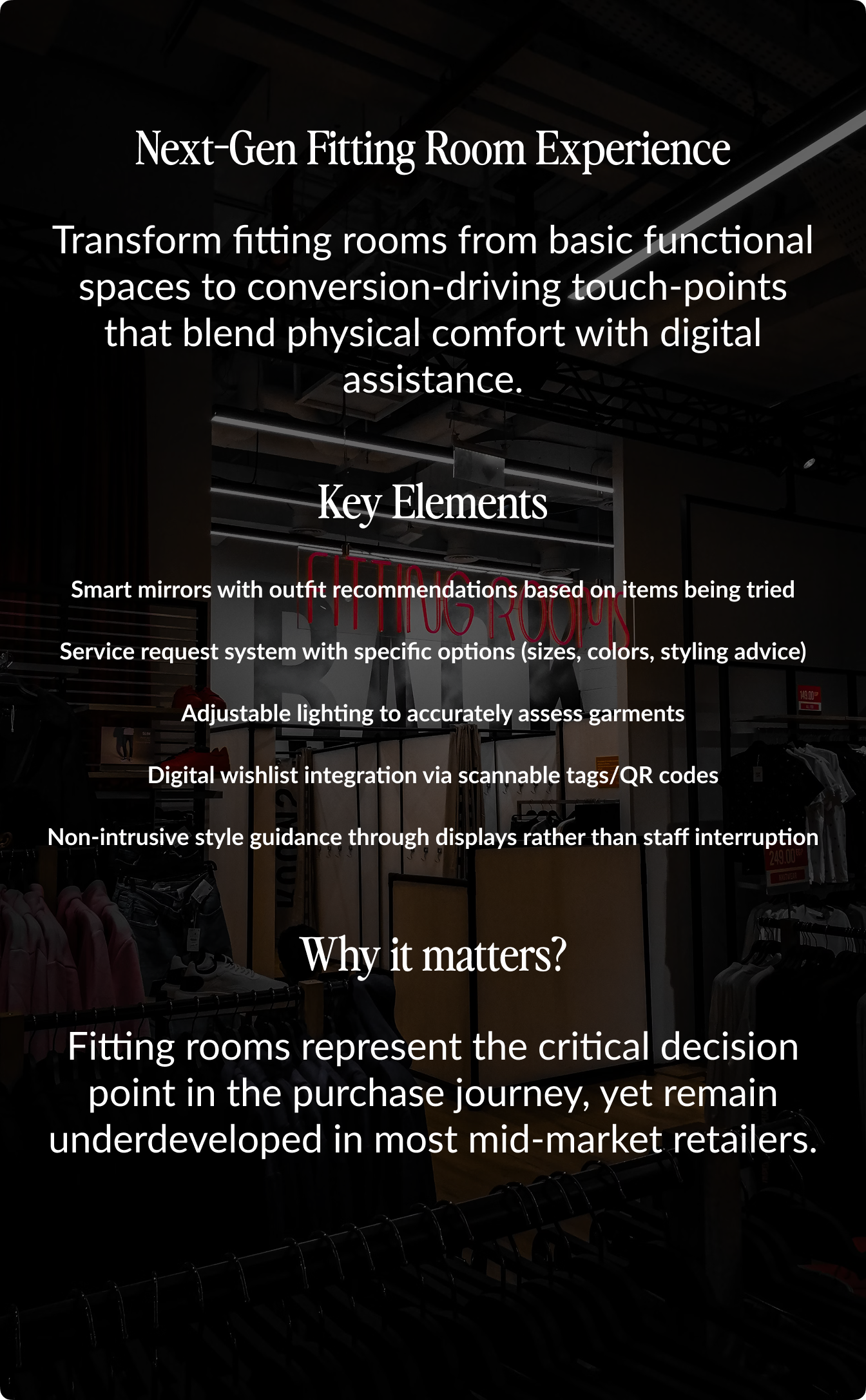
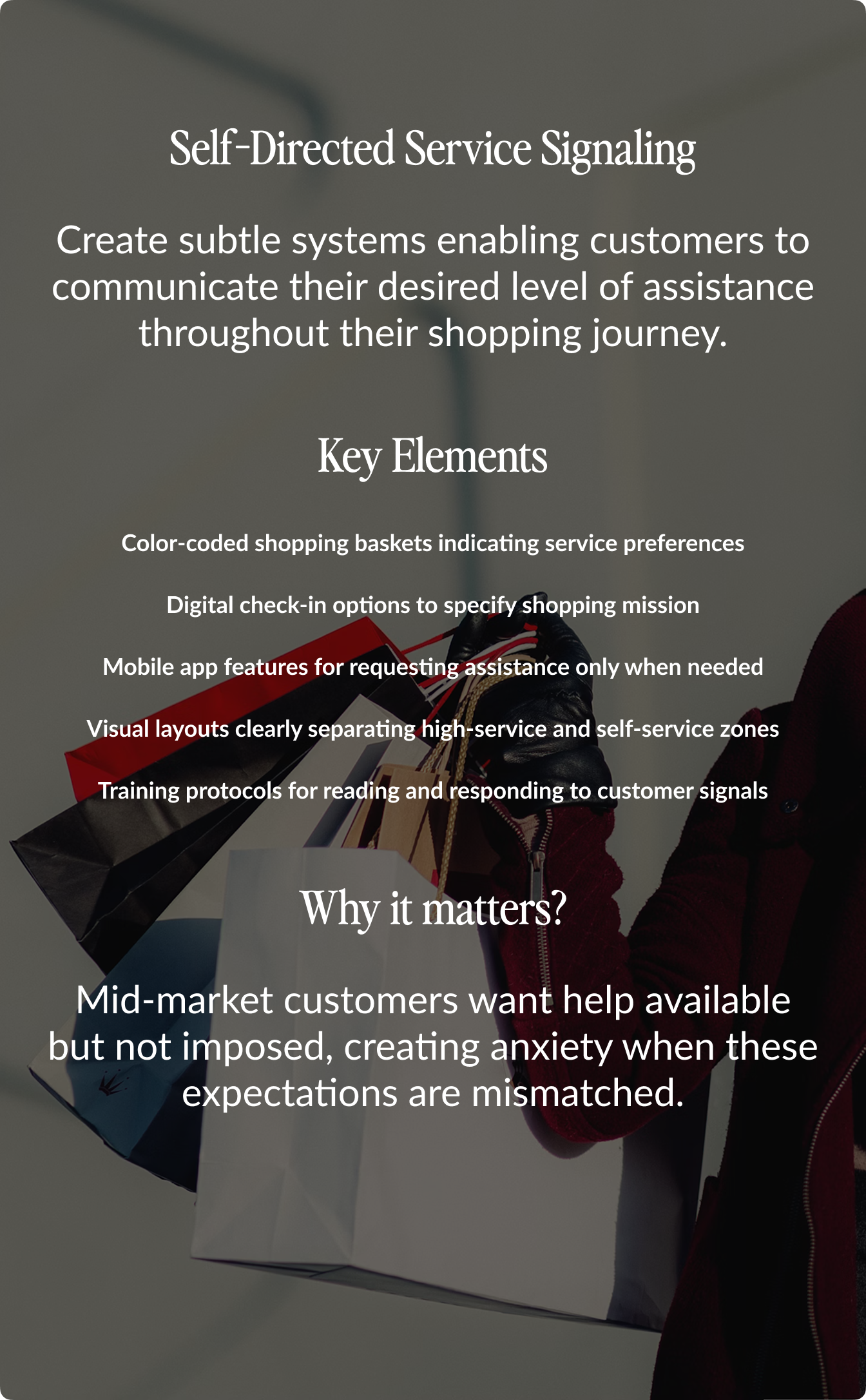
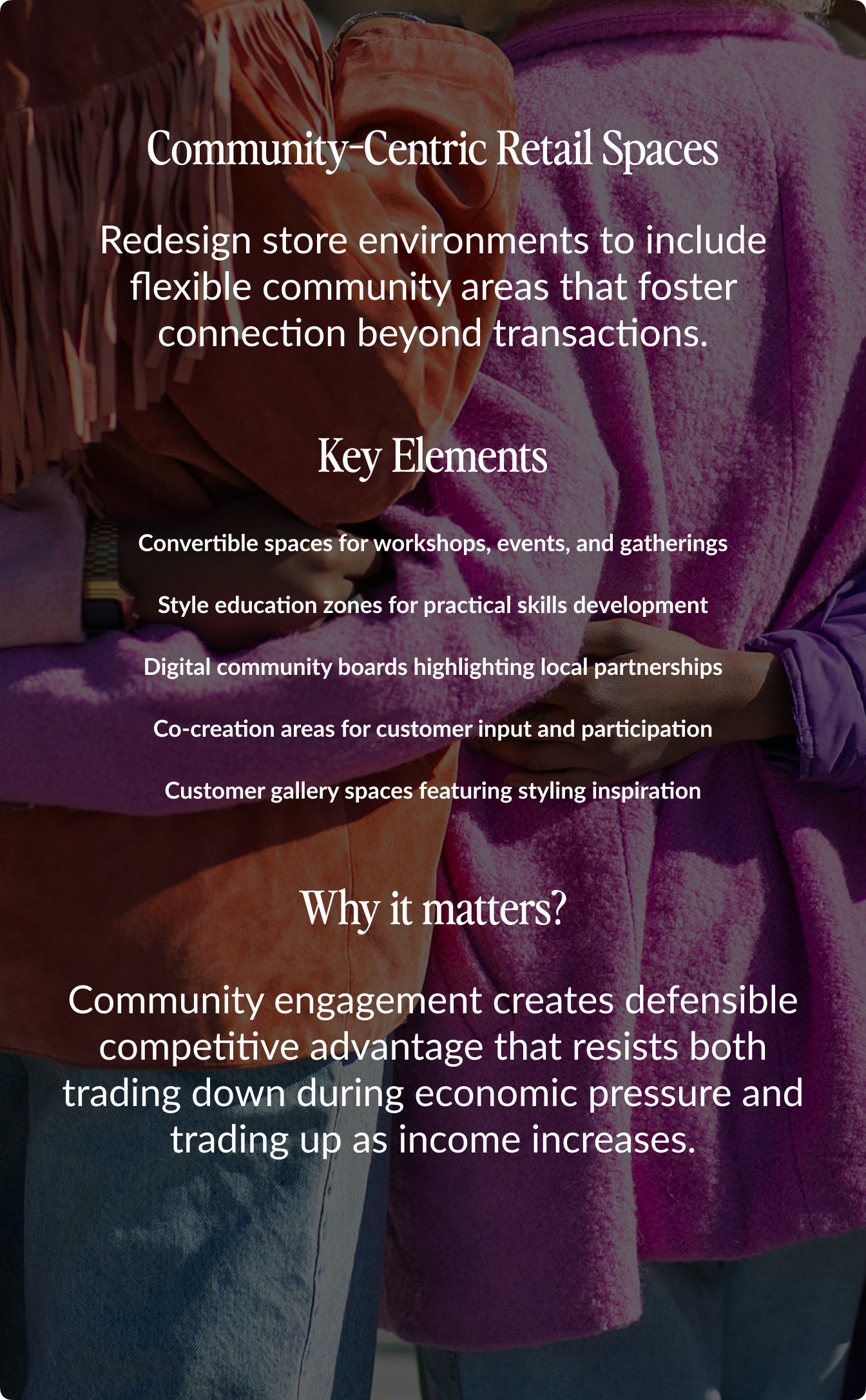
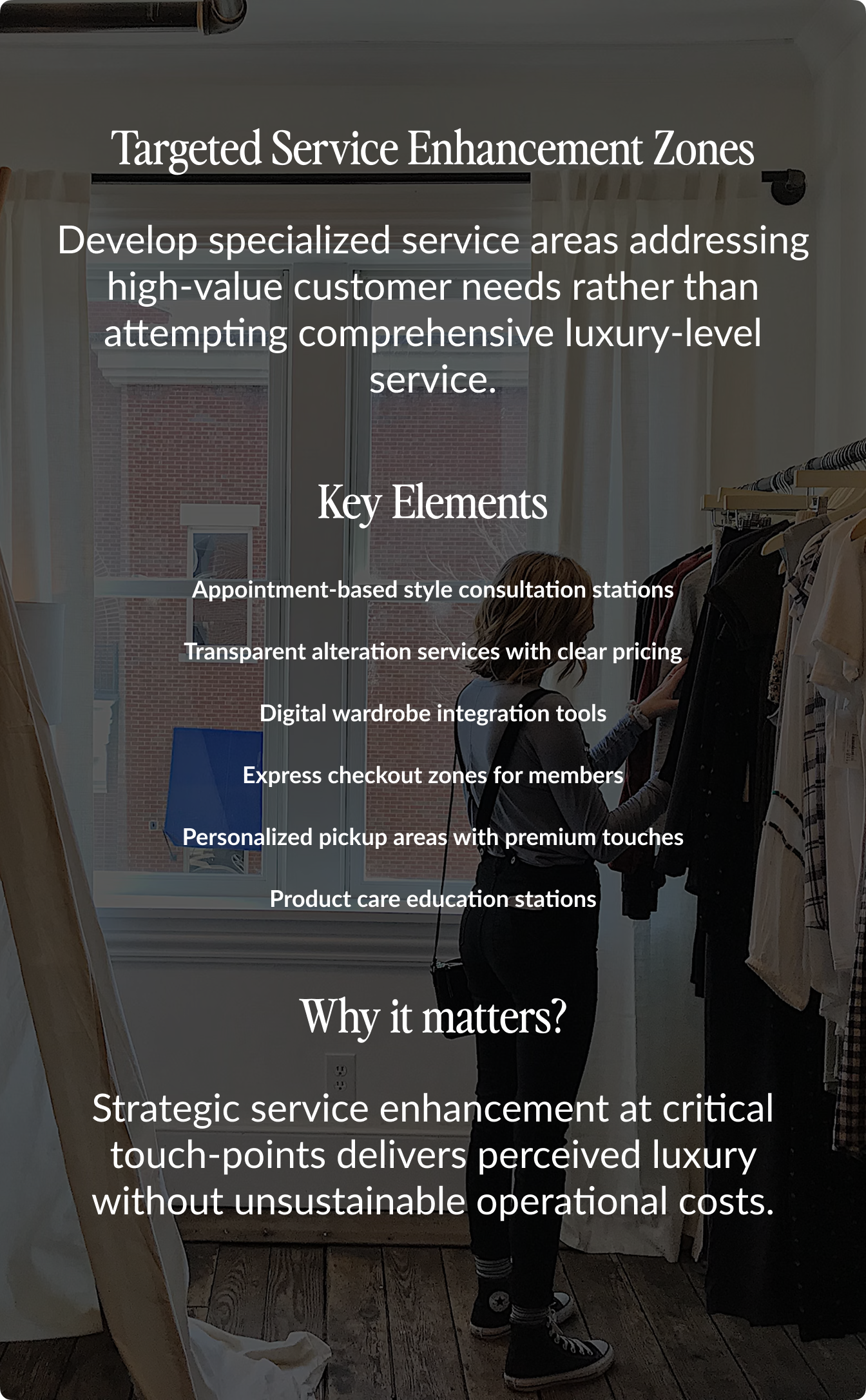
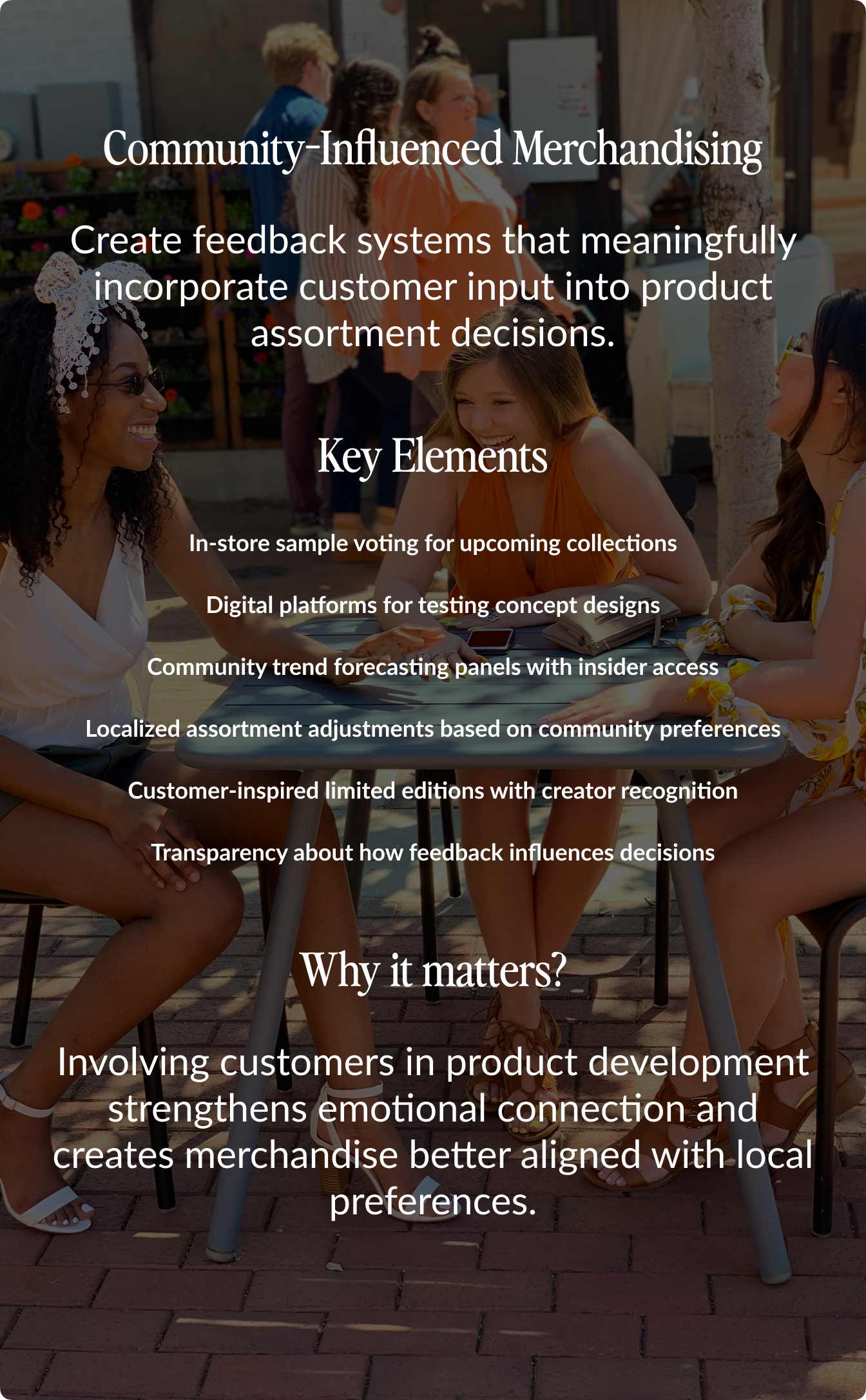
The shortlist in one line: fitting rooms, service signals, community spaces, enhancement zones, community-informed merchandising. The fitting room is first because it is the measured bottleneck. The rest are ordered by how directly they convert community engagement into repeat purchase.
What the study is really for
Mid-market is not going to out-cheap fast fashion or out-aspire luxury. The only durable positioning is to be the category that respects the customer’s time, money, and intelligence, and to put operational investment exactly where the journey is measurably breaking. For Emma, that is the fitting room. For the brand, that is a 5 to 10 percent price premium spent on things that reduce friction instead of staging it.
The five opportunities are not a deployment plan. They are a shortlist of places a mid-market brand can put the premium and have the research back up the bet.
中段是挤,不是空
中端时尚是那种没什么人替它加油的类目。奢侈品有它的神秘感。快时尚有它自己的账算得过来。中段留下的是 Banana Republic、J.Crew、Madewell、Coach、Lululemon,和一道算不过来的账。
开题时带的是最容易的假设:中段在死,是因为消费者抛弃了它。问卷讲的是反着的故事。
43.3% 向中端迁移
- 43.3% 向中端迁移
- 33.4% 向快时尚或奢侈品迁移
- 21.7% 保持原有习惯
中段并没有停滞,它在被重新填满,主要是从奢侈品那一头被价格挤下来的消费者。他们带着奢侈级的服务期待,和低于奢侈的价格承受度一起进来。
那 48.3% 到底想要什么
有一块溢价是能抓到的,但很窄。而且这块钱是留给「靠谱」的,不是留给「演奢侈」的。
这块溢价很窄,也有指定用途
一项 15% 的运营投入会落到这条线的错误一侧。任何需要更高毛利来支撑的动作,都不在范围内。季度支出的偏好分布讲的是同一件事。
维持增强会员的偏好季度支出
会员权益应该按 800–1,200 美元的年度起跳线去分档。再低显得廉价。再高就把目标人群挡在门外。
基础胜过花样
让顾客强制排序服务要素,层级是稳定的。运营质量在最上面,奢侈信号在最下面。
服务要素平均评分(1–5)
那些只负责发出「身份感」信号、但会拖慢交易的奢侈动作,在评分里是负分。靠谱赢。
会员权益按平均评分排序
奢侈品用来标记「你是会员」的那些权益(造型师、活动)排最低。运营上最便宜的那些排最高。跑起来最便宜的计划,正好也是被最想要的。
「做得扎实:靠谱、高效、对品质有追求的零售,同时尊重顾客的时间和钱。」
研究命题 · 由 130 条洞察归纳
三场访谈,一个结论
三个角度,一个结论。真实胜过剧本,克制胜过殷勤,试衣间的质量是底线。
「老顾客就是家人。」
把会员视作黏合剂。认为服务应该是个人化的,不管客流多忙。甜蜜点:不推销的个性化服务。痛点:高峰期如何分配注意力。
「我就想找到我的码,然后走。」
看重顺畅的流程和设计得像样的试衣间。任何发推送轰炸的计划都会被退订。甜蜜点:隐私和效率。痛点:贴身跟着的店员、用帘子代替门的试衣间。
「帮助应该是一个按钮,不是一个人。」
被问到时,愿意接受搭配建议。直接提出「试衣间里需要一个呼叫铃」。甜蜜点:随叫随到但安静的服务。痛点:带推销感或带偏见的对待。
Banana Republic 对 Lululemon,一街之隔
Savannah 的 Broughton Street 上两家店相距不到一百码。前后脚观察,这两家的服务策略差异就看得清楚了。
传统零售
氛围:极简、优雅,轻柔背景乐,有舒服的休息区。店员:按意愿介入,不打扰。会员:只在结账时出现。节奏:浏览 10–20 分钟,转化率高,店员和顾客之间的边界清楚。
社群模式
氛围:陈列密集,音乐上扬,工业冷暖色。店员:主动聊天,边界被刻意模糊。会员:大使计划展示,信息以生活方式为先。节奏:专门的试衣间店员、30 天试用、缺货直接寄到家。
两家都能转化。没有哪种是错的。这里的真正结论是:中端有两种对抗快时尚和奢侈品的防守位(运营极致或社群归属),品牌必须挑一个。两边都做一点,做出来的门店就是个「泛品牌感」。
认识一下 Emma
Emma,28 岁,市场专员。去年从快时尚切换出来,逛店之前先上网做功课,每件衣服都会在脑子里算一次「每次穿的成本」。她那句话,是整项研究一句话的版本。
「我愿意为能穿得久的好货多花钱,但我得感觉到那个价值对得起价格。」
Emma · 代表性画像
试衣间才是决定点
把 Emma 的旅程按「研究 → 到店 → 试穿 → 下单 → 购后」画完,跳出来一个非显然的发现:她的情绪最低点不是结账,是试衣间。
试衣间是购买决定真正发生的地方,也是中端投入最少的地方。用帘子代替门。没法不穿回衣服就换一个码。愿意在对的时机来帮忙的那位店员,也没有任何反馈通道让他知道该什么时候出现。店里其它地方可以做得再好,一个糟糕的试衣间还是会把这单丢掉。
130 条洞察,12 类主题,5 个押注
两周的亲和图归纳把问卷的开放回答、访谈原声、观察笔记合进一套共同的语法。
中端可以把溢价投在五处
这五个设计机会,是把 130 条洞察翻译成「5–10% 溢价可以合理投向哪里」。
一行总结:试衣间、服务信号、社群空间、服务增强区、社群驱动选品。试衣间放第一,是因为它是被量过的瓶颈。其它按「把社群参与转化成复购的直接程度」排序。
这项研究到底在为什么服务
中端不会在价格上压过快时尚,也不会在向往感上盖过奢侈品。唯一可持续的定位,是做那个尊重顾客时间、钱和智商的类目,把运营投入放到旅程里真正被量到会断掉的那些地方。对 Emma 来说,就是试衣间。对品牌来说,就是把 5–10% 的价格溢价花在「减少摩擦」,而不是「演出仪式感」。
这五个机会不是部署计划。它们是一张候选清单:一个中端品牌可以把溢价押在哪几个位置,同时有研究在背后站着。